


What is an EHS event ?
The INRS classifies adverse events according to their consequences in its guide on workplace accident analysis :
- Accident : an adverse event that causes harm to people. It becomes a workplace accident within the meaning of Article L.411-1 of the Social Security Code if it occurs during or as a result of work.
- Near-miss : an adverse event with no resulting damage. Example: an employee slips on a wet floor but catches themselves.
- Incident : an adverse event that damages facilities, equipment, a process, or the environment within the company's premises. Example : a chemical leak caused by a valve that was not properly closed.
The ISO 45001 standard uses a broader definition: an incident refers to any work-related event that results in, or has the potential to result in, injury or ill health. Near-misses are therefore included.
What is a non-conformity ?
In ISO management system standards (9001, 14001, 45001), a non-conformity is the failure to fulfill a requirement. The requirement may stem from :
- regulations (Labor Code, Environmental Code, ICPE prefectural decree)
- the standard targeted for certification
- a client or contractor (specifications, MASE framework)
- the company itself (procedure, operating method, instructions)
A non-conformity does not imply any damage. A fire extinguisher with an expired annual inspection is a non-conformity, even if no one was injured.
How do you classify a field report ?
Three questions are sufficient in most cases.
- Was someone injured, or could they have been ? If yes, it is an HSE event (accident or near-miss).
- Was equipment, a facility, or the environment affected ? If yes, it is an incident, to be categorized under safety or environment.
- Was a requirement not met ? If yes, a non-conformity is opened, in addition to the event if one exists.
Why does the classification change the process ?
A workplace accident triggers legal obligations. The employer must report it to the CPAM or MSA within 48 hours, excluding Sundays and public holidays, as noted by Service Public Entreprendre. The analysis must then be used to update the single risk assessment document (DUERP).
A near-miss does not require external reporting. However, the INRS recommends recording and analyzing it, especially if it recurs : it is a weak signal before an accident.
A non-conformity follows the continuous improvement cycle: immediate correction, root cause analysis, corrective action, and effectiveness verification. This is what auditors check under section 10.2 of ISO standards.
Misclassifying a report therefore carries two risks: missing a legal deadline or skewing indicators (frequency rate, number of open non-conformities).
What should you do when a report falls into both categories ?
This is common. You open the HSE event, then attach the non-conformity to it. The two records remain linked : the corrective action decided for the non-conformity is also what prevents the event from recurring.
This link is difficult to maintain in a spreadsheet, where events and non-conformities often live in two different tabs or files.
How does QHSE software help with classification ?
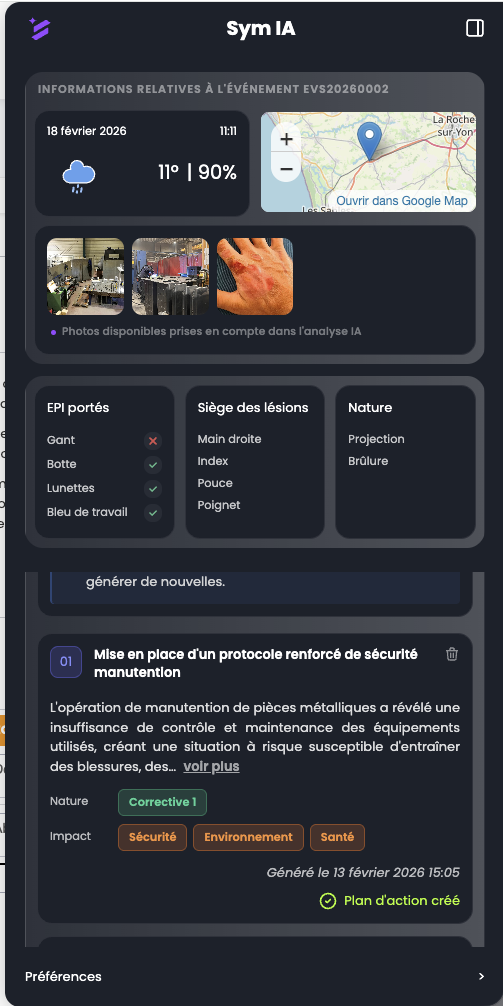
In the Symalean Safety module, the reporter submits the event from their mobile device, including a photo. The manager can message them directly within the report to request clarification or an additional photo.
SymAI, the AI integrated into Symalean, then suggests a classification : EHS event, non-conformity, or both. It bases this on the content of the report and the exchanges with the reporter. Data remains hosted on HDS-certified servers, in compliance with GDPR and the AI Act.
What remains human : validating the classification, deciding whether to report a workplace accident, and choosing the actions to take. SymAI prepares, the QHSE manager decides.