

What is a near-miss ?
The INRS defines it as an undesirable event that results in no damage. A load falling near an operator, a forklift braking in time, or a slip that was caught before a fall.
There is no external obligation to report them. However, the INRS recommends recording all accidents, near-misses, and incidents, and analyzing them, especially when they recur. The ISO 45001 standard includes them in its definition of an incident : a certified site must therefore be able to demonstrate how it handles them.
Why don't field teams report them ?
The barriers are almost always the same :
- Fear of being judged, disciplined, or getting a colleague in trouble
- Time : paper forms or a computer terminal located far from the workshop
- A sense of futility : "nothing happened," "nothing ever changes anyway"
- Confusion : the operator doesn't know if what they saw "counts"
- The channel : reports are made via WhatsApp or verbally to the team leader, and get lost
6 ways to increase near-miss reporting
1. Report directly from the workstation
Reporting should happen right where the event occurs, using a smartphone or a shared tablet. A photo and two fields are all it takes: what happened and where. The rest can be filled in later.
2. Don't ask the reporter to categorize it
The operator describes the facts. It is up to the QHSE manager to decide whether it is a near-miss, an incident, or a hazardous situation. Removing this question removes hesitation.
3. Guarantee no disciplinary action
The rule must be written down and reiterated by management: reporting will not lead to sanctions. The analysis focuses on the work situation, not the individual. This is also the INRS principle for accident analysis : stick to the facts, without interpretation.
4. Respond to the reporter
A simple "thanks, we're looking into it" within the day changes the perception. Even better : ask a question or request an additional photo. The reporter sees that their input is being read.
5. Show what has changed
Every month, highlight two or three actions taken as a result of near-miss reports. During safety briefings, tell the story: the report, the analysis, and the fix.
6. Track the right metric
An increase in the number of near-misses is often good news: it measures vigilance. Track the ratio of near-misses to accidents by site and team, rather than aiming for "zero reports."
What should you do with a reported near-miss ?
- Record it with the date, location, people involved, and circumstances.
- Categorize it and assess its potential severity : what could have happened ?
- Analyze it if the potential severity is high or if it is a recurring issue (5 Whys, cause tree).
- Decide on an action and follow it through to completion.
- Update the risk assessment if the hazard was not previously included, as recommended by the INRS in Travail & Sécurité.
How does QHSE software facilitate reporting ?
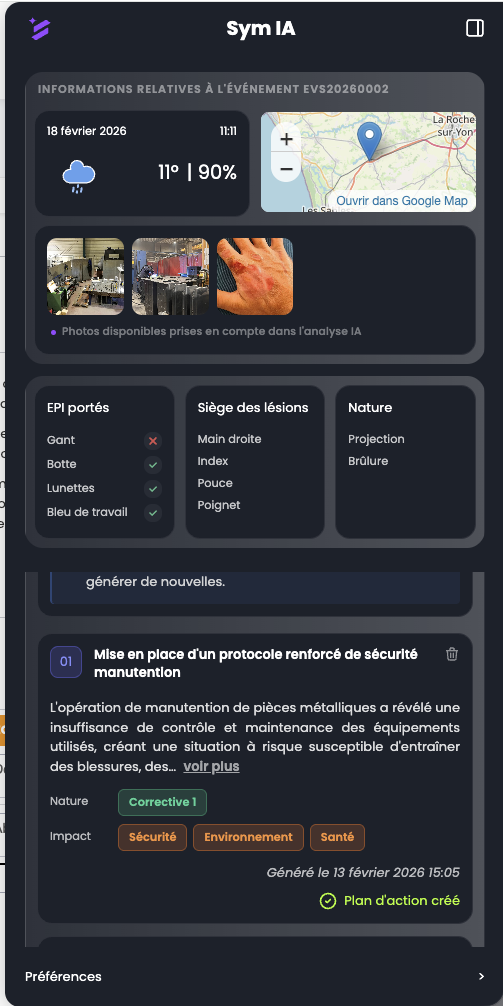
With the Symalean mobile app, operators can file a report in seconds, including photos. Managers can respond directly within the report's built-in messaging system, avoiding informal WhatsApp groups. The entire exchange remains linked to the event.
SymAI then suggests a classification for the report (EHS event or non-conformity) and prepares the file. The QHSE manager validates it, makes any necessary corrections, and then initiates the analysis or action.
What remains human : a culture of trust. No tool can replace a manager who shows appreciation and leadership that avoids punitive measures.