

Centralization and data uniqueness
Using a solution like Symalean allows you to centralize all useful information in one piece of software that everyone involved in the system can access. This ensures that everyone has the data they need to manage their activities, carry out their tasks, or simply stay informed.
Everyone works from the same base, which is updated in real time. Each form is filled out collaboratively, avoiding version control issues with documents in circulation. Linking the various features ensures that everyone has the right information (the same for everyone) at the moment they need it.
Consolidating action plans and non-conformities
Too often, each component of a management system has its own action plan or even its own non-conformity register: one for quality, another for the environment, and another for safety.
It is more effective to consolidate these records, regardless of their domain, into a single point and manage all of the organization's actions in one master register.
Consolidating these elements into a single solution first provides a global view of events occurring within the organization and the actions taken. It also creates synergies between processes and areas of expertise. Our article on how to link action plans and non-conformities details this logic.
Traceability of records
Managing all these records (actions, non-conformities, audits, risk assessments, workplace accidents) in a single solution ensures their traceability. In often complex systems, it is essential to track your records effectively and to easily find and analyze their origin.
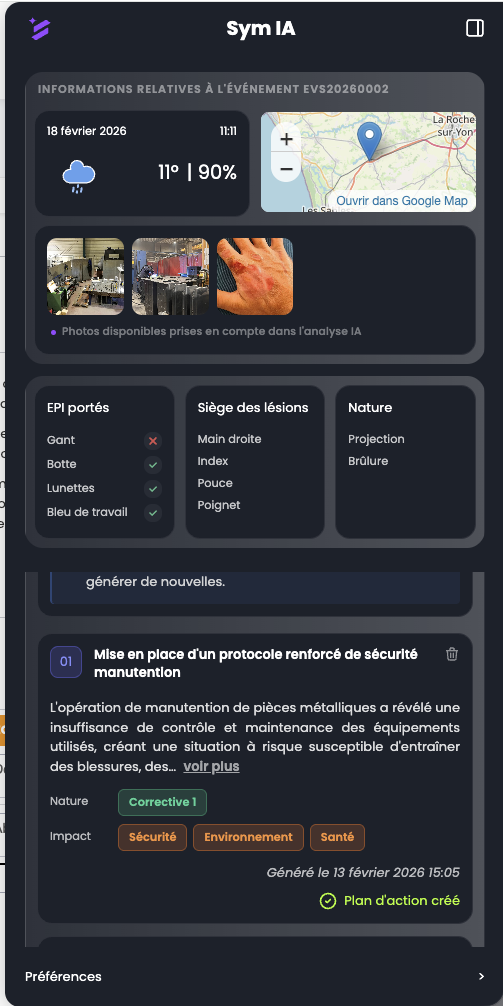
Imagine that following a workplace accident, you want to initiate a corrective action. With Symalean, you create this action directly from the accident form. The action is automatically added to the global action register. The link is visible from the accident form, where you can track all actions initiated from it, and from the action card, where the origin is noted. The same logic applies to the single document, strategic and operational objectives, issues, and interested parties.
These are just examples, but the value of naturally linking all components of a management system is clear for process management.
Connecting every component of an organization ensures access to the right information, creates synergies between often siloed areas of expertise, and makes it easy to identify the origin of every record. It is a key success factor for an efficient management system.
Why does centralization matter even more in 2026 ?
Standards are evolving: ISO 14001:2026 was published in April and ISO 9001:2026 on September 16. A management system with scattered registers takes longer to update with each revision. A single database allows you to update shared information across domains just once. See our article on the ISO 9001:2026.
This single database also prepares you for the use of AI: an assistant is only useful when data is complete, linked, and up to date. Before activating it, ask yourself the right questions with our 10 questions to ask your vendor.
To structure the foundation itself, start with the mapping of your processes, then discover how a QHSE management software connects processes, risks, actions, and audits.