

What is a non-conformity report used for ?
An NCR is not just for logging a problem. It allows you to :
- track what was observed, when, where, and by whom ;
- decide on the immediate corrective action to be taken ;
- analyze the root causes to address the source rather than the symptom ;
- monitor actions, those responsible for them, and their deadlines ;
- provide proof of the resolution during an audit and capitalize on findings for the management review.
When should you open a non-conformity report ?
As soon as a discrepancy from a requirement is observed, in any field
- Quality : non-conforming product or service, late delivery, procedure not followed, verified customer complaint.
- Health and safety : missing collective protection, personal protective equipment not worn, periodic inspection not performed, safety instructions not followed.
- Environment : improper waste sorting, discharge exceeding thresholds, product storage without containment.
- Audit : discrepancy identified during an internal, customer, or external audit.
The threshold for opening a report must be defined in advance. Without clear rules, some teams under-report for fear of the administrative burden, while others open a file for everything.
What should a non-conformity report contain ?
Four sections are sufficient for most organizations. Here is a template to copy and adapt :
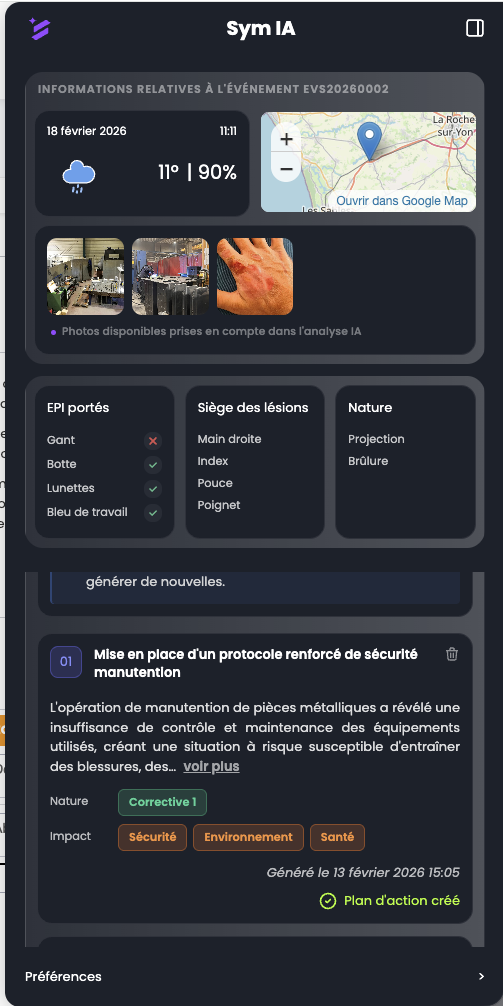
Example of a completed report
Illustrative example, not linked to any client.
Who fills it out, who processes it ?
- The reporter describes the discrepancy : any employee should be able to do this, on the ground, in a few minutes.
- The quality, safety, or environmental manager qualifies the report, categorizes it, and assigns the actions.
- The action owner carries out the action within the set deadline.
- The approver verify effectiveness and close the report.
The shorter the process, the more issues will be reported. A form with twenty mandatory fields has the opposite effect.
Paper forms, spreadsheets, or dedicated tools
A paper form or spreadsheet works as long as the number of issues remains low. Beyond that, the same difficulties arise: re-entering data, missed deadlines, photos stored separately, and no metrics without manual consolidation.
A non-conformity management software addresses these points : field reporting with photos, with or without an internet connection, classifying each report as a non-conformity, event, or action plan, assigning actions with deadlines, alerts for delays, and a history accessible for audits. Data is thus created in the correct format from the start, without intermediate files. For the collection process itself, see our article on managing HSE data at the source.
Non-conformity reports and standards
The report is not mandated in this specific form by standards, but they do require that non-conformities be addressed and that records be kept :
- ISO 9001 (quality) : requirement 8.7 concerns the control of non-conforming outputs, and requirement 10.2 concerns non-conformity and corrective action. Specifically, you must react, evaluate whether to eliminate the causes, implement actions, verify their effectiveness, and retain documented information.
- ISO 14001 (environment) and ISO 45001 (occupational health and safety) : requirement 10.2 also deals with non-conformity and corrective action (for ISO 45001, this includes incidents).
The non-conformity report (NCR) is the most common way to produce these records. The format remains flexible: what matters is the traceability of the resolution process.
Six tips for a useful report
- Describe the facts. "Fire extinguisher not inspected for over a year," not "poorly maintained equipment."
- State the requirement that was not met. Without a reference, the discrepancy is open to debate.
- Treat the cause, not just the symptom. Correcting without analyzing is setting the stage for a recurrence.
- Assign an owner and a deadline for every action.
- Verify effectiveness before closing. A completed action is not necessarily an effective one.
- Review all reports regularly : recurring discrepancies reveal an underlying issue.