

Centralization isn't enough
Consolidating data into a single tool is a good first step, but it doesn't solve everything. A central database filled with late, incomplete, or manually re-entered reports remains difficult to use: KPIs become skewed, action plans are delayed, and audits reveal gaps that could have been identified much sooner.
For more on how to structure this data within your organization, see our article on centralizing organizational components. Here, we look at what happens beforehand: collection.
Where does HSE data quality break down ?
Four points of failure frequently occur in organizations with field operations (construction sites, workshops, warehouses, multi-site facilities) :
- Delays. A hazardous situation noted on paper in the morning might not be entered until the evening or the following week. Details fade, and the context is lost.
- Manual re-entry. Every time data is copied, it introduces errors, missing fields, and unnecessary administrative time.
- Lack of network connectivity. Basements, dead zones, and remote sites: if your tool requires a connection, reporting gets put on hold.
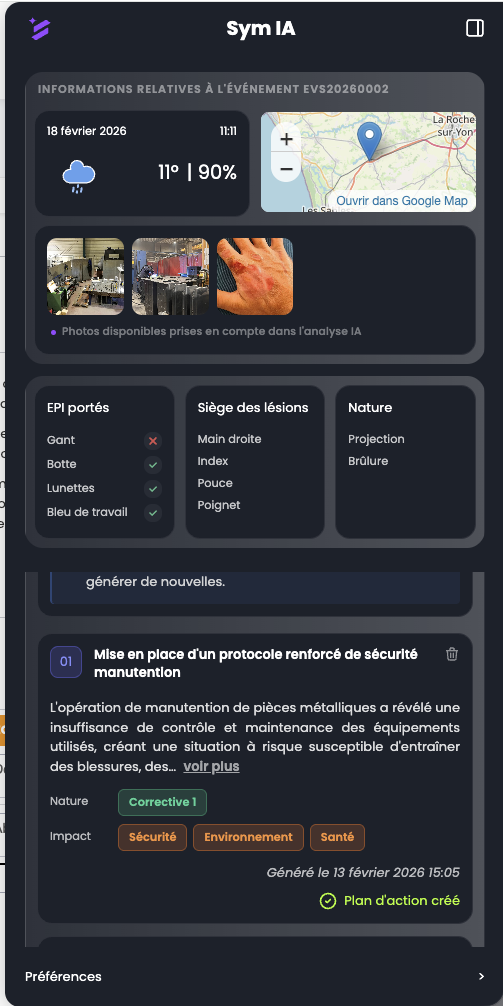
- Lack of evidence. Without photos or videos, non-compliance issues are harder to qualify and resolve.
What difference does a field application make ?
Clear mobile QHSE application addresses these four points at the source. The Symalean mobile app allows you to :
- report on-site a non-conformity, conduct an audit or HSE inspection, with photos and videos ;
- enter data with or without an internet connection, so you don't lose any reports in areas without network coverage ;
- categorize and track every report as soon as it is filed, instead of sorting it later at the office ;
- receive alerts and reminders for audit deadlines, certifications to renew, and overdue actions ;
- assign an action, comment on a report, and share a document, from the field to the office, all using the same data.
Data is thus created in the correct format, directly within the management system. No intermediate files.
Why is this also a regulatory issue ?
Employers must take the necessary measures to protect the health and safety of workers and implement an appropriate organization, as provided for by articles L4121-1 and following of the Labor Code. Furthermore, the single document must be updated when additional information relevant to risk assessment is collected, according to article R4121-2. Field reports are one of the primary sources of this information: the faster and more accurate they are, the more up-to-date the risk assessment remains.
For accident analysis, the INRS offers a guide for analyzing workplace accidents and taking action for their prevention (ED 6481). Near-misses are valuable signals, as detailed by INERIS in its investigations into near-misses.
From data to decision
Once data collection is reliable, you can start putting it to work: prevention metrics (number of reports, processing time, action closure rates), management dashboards, and site comparisons. Artificial intelligence can also help categorize reports and suggest corrective actions, subject to human validation. See our article QHSE AI Agent : definition, practical uses, and limitations.
Six criteria for evaluating the field-use capabilities of QHSE software
- Does it work offline, and how does data synchronization happen afterward ?
- Does it allow you to add photos and videos to a report ?
- Does it cover reports, audits, inspections, and action plans, or only a portion of these ?
- Are alerts (deadlines, certifications, overdue actions) built-in ?
- Can access rights be configured by profile and by site ?
- Does field data entry feed directly into dashboards without the need for re-entry ?