

The situation in the field
Illustrative example. A forklift operator reports from their phone: "Pallet poorly secured in aisle 4, it almost fell on a colleague." They attach a photo.
This statement could fall under three different categories: a near-miss (nothing happened, but the risk was real), a non-conformity (a storage rule was not followed), or both. The next steps depend on this choice: who is alerted, what analysis is performed, what action is taken, and what the deadline is.
Without AI : sorting depends on the person and the timing
In many organizations, a manager reads each report, decides on its category, and then re-enters it into the correct register. Common challenges include :
- sorting takes time when reports pile up ;
- two people might classify the same situation differently ;
- photos are viewed separately, or not at all ;
- a misdirected report arrives late in the correct workflow.
This is an extension of the topic of quality of field data collection : data that is captured well must also be routed well.
With SymAI : a classification proposal, validated by a person
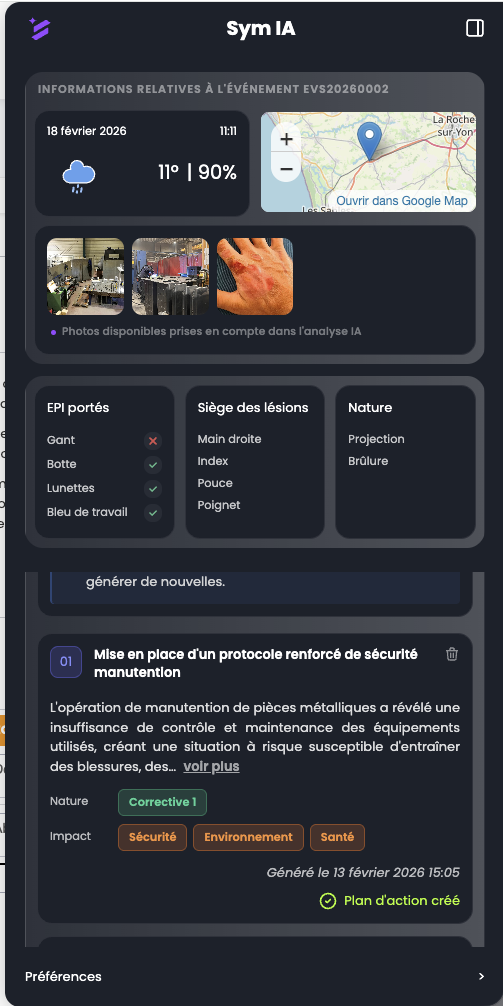
SymAI, Symalean's AI agent, reads the text of the report and analyzes the attached photo. It proposes :
- a category : non-conformity, workplace accident, or near-miss ;
- a summary of the situation in a few lines ;
- routing to the relevant module : Events, Non-conformity, or Action Plan.
The person processing the report confirms or corrects the suggestion. Nothing is finalized without their input.
What AI does not do
- It does not make decisions on its own: human validation remains the rule. See our article QHSE AI Agent : definition, practical uses, and limitations.
- It does not replace site-specific knowledge. If the report is vague or incomplete, its suggestion will be too.
- It does not draw conclusions about individuals : it qualifies a situation, not an employee.
Accident reports may contain health data. Where this is processed and hosted matters : see QHSE AI and health data.
For whom, and for what purpose ?
- QHSE Manager : less manual sorting, more time for analysis and action.
- Site Manager : reports routed more quickly to the right person.
- Management : a more consistent register, leading to clearer indicators.