

Why do photos matter in a report ?
Field reports are often just a single sentence. Photos provide what words leave out: the condition of the floor, aisle obstructions, the position of safety guards, or the immediate environment. They provide both evidence and context.
In practice, photos are attached to reports but rarely utilized; the person processing the report may or may not look at them, depending on their workload. For actual accident analysis, the INRS provides a guide for analyzing workplace accidents and taking action for their prevention (ED 6481).
What AI can extract from them
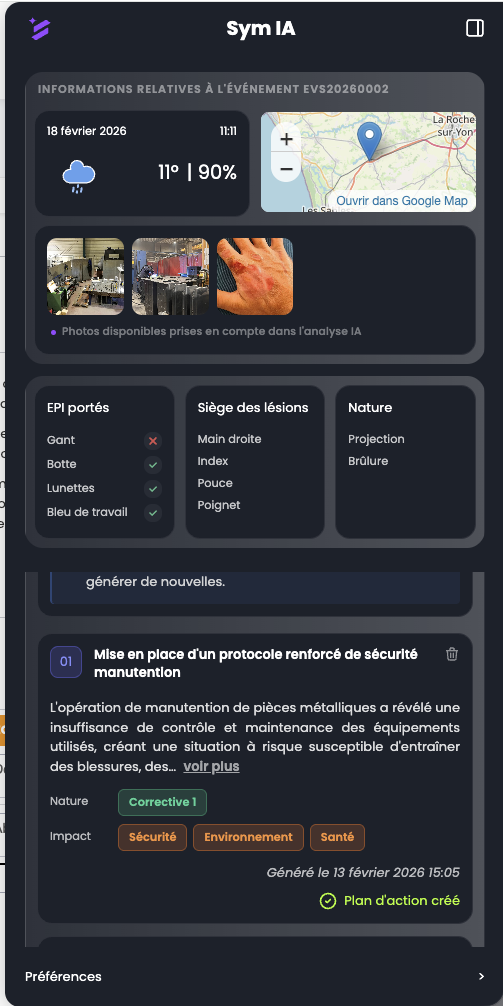
Illustrative example. An employee reports : "Fall in aisle 3". They attach a photo of the aisle.
With SymAI, the analysis can correlate the text and the image to :
- describe the scene : a traffic aisle, pallets stored along the edge, a shiny-looking floor ;
- flag what is visible and potentially related to the situation, without drawing definitive conclusions ;
- indicate what the image cannot determine : the cause, circumstances, or nature of an injury ;
- enrich the summary of the report that the processor reads before deciding on the next steps (see How to classify field reports using AI).
The person processing the report remains in control : they confirm or correct the interpretation, then decide on the next steps.
Limitations to keep in mind
- A photo is just a snapshot in time. Angle, lighting, and framing: it shows neither what happened before nor the organizational causes.
- AI describes ; it does not investigate. Determining the causes of an accident requires cross-referencing testimonies, work organization, and on-site facts.
- People in the image. An image where a person is identifiable constitutes personal data under the GDPR, and may reveal health-related information. Frame the scene, not faces, and verify where the image is processed and hosted : see QHSE AI and health data.
- Human validation. An image analysis can be incomplete or incorrect. It only has value when reviewed.
IMPORTANT : our ethical charter and your data protection
An accident photo may contain people, locations, or sensitive information. At Symalean, SymAI is a proprietary AI developed by Symalean, with specific commitments :
- Anonymization : personal data contained in reports (text, images) is anonymized before being analyzed by the AI.
- Hosting : Data is hosted on HDS-certified (Health Data Hosting) servers.
- GDPR : Symalean processes data in accordance with the General Data Protection Regulation.
- AI Act : SymAI is designed in compliance with the European AI Act, particularly regarding user information and human oversight.
- ISO/IEC 42001 : Symalean has initiated the certification process for ISO/IEC 42001, the standard for AI management systems.
- Human decision-making : SymAI makes suggestions, a person validates them. No decision is made by the AI alone.
Find all of these commitments in our ethical charter.
Five tips for a usable photo
- A wide shot, then a detail shot. Context first, then the specific element involved.
- A scale reference whenever possible (a known object, a marked area).
- Lighting and focus : a blurry or dark photo cannot be read by a human or an AI.
- No faces. Frame the workstation and equipment, not the people.
- Without putting yourself in danger. Safety comes before photos : secure the area first, then take your pictures.
To ensure these photos are correctly uploaded to the system, see the quality of field data collection.