

Why link every event to the DUERP ?
The DUERP is the document in which the employer records the results of the risk assessment. It is not updated annually alone. Article R4121-2 of the Labor Code requires an update :
- at least once a year in companies with eleven or more employees ;
- whenever there is a major change in planning that affects health and safety conditions or working conditions ;
- whenever additional information relevant to risk assessment is brought to the employer's attention.
An event (accident, reported hazardous situation) is typically information of this nature. It raises two questions : was the risk included in the DUERP, and did the planned preventive measures perform as expected ?
Without AI : a lost connection
In practice, linking an event to the DUERP is done manually :
- the DUERP is a voluminous document (spreadsheet or PDF), organized by work unit ;
- finding the right entry requires knowing the document by heart ;
- the link between the event and the entry is not always tracked ;
- the DUERP is updated once a year, sometimes without taking into account what happened in the meantime.
This is an extension of the topic of field data collection and the incident reporting classification : once an event is recorded, it must inform the risk assessment process.
With SymAI : a proposed match, an update decided by a person
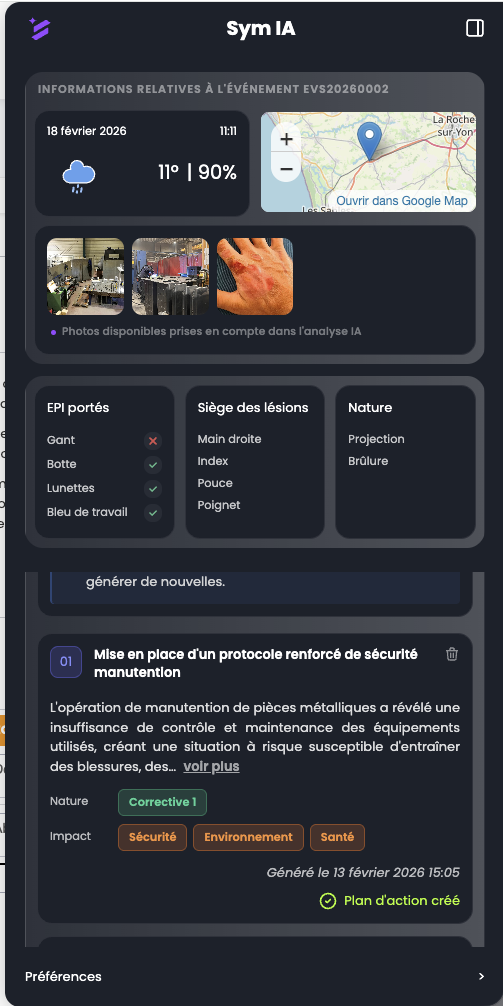
Illustrative example, following on from case 1. An employee was injured while unloading a truck. The event is recorded.
SymAI can then :
- Match the event to a line in the risk assessment document (DUERP) : for example, the work unit "loading dock," the hazard "manual handling of loads."
- Compare the situation against planned preventive measures : handling aids, training, dock organization. It highlights those whose implementation appears to be lacking based on the report.
- Propose new preventive measures when existing ones appear insufficient.
- Flag the absence of a corresponding entry when no risk in the DUERP matches the situation : this is a sign that a hazard had not been identified.
The person in charge reviews, accepts, or rejects the proposals, then updates the DUERP and the action plan.

What AI does not do
- It does not rate the risk for you. Risk rating and prevention decisions are the responsibility of the employer, who remains accountable for the assessment.
- It does not modify the DUERP without validation. It proposes, a person decides.
- It does not verify the reality on the ground. If the report is incomplete, the reconciliation will be too : AI must flag what is missing, and an on-site inspection remains necessary.
- It does not analyze the root causes on its own. To trace the root causes of an accident, see the analysis method (cause tree, 7M, etc.), which will be the subject of a future use case.
Five questions to ask after every event
- Is the hazard included in the DUERP for the correct work unit ?
- Is the risk rating still consistent with what just happened ?
- Were the planned preventive measures actually in place ?
- Should more be added, or should they be strengthened ?
- Are the DUERP and the action plan updated, with a record of the link to the event ?