Why is the industrial sector a natural fit for ISO 45001 ?
ISO 45001 structures an occupational health and safety management system around hazard identification, risk assessment, and continuous improvement. On an industrial site, this structure is immediately relevant : hazards are numerous, varied, and often amplified by the proximity of classified installations to ongoing human activity. We have detailed the process mapping method specific to this standard in our article on ISO 45001 mapping.
Hazard identification: a different exercise for a classified site
The continuous identification of hazards, required by clause 6.1.2.3 of the standard, takes on a specific dimension when the site in question falls under the classified installations regime. Industrial accident history regularly reminds us that seemingly neutralized installations can remain dangerous, a point we developed in our article on industrial safety based on BARPI data. Hazard identification on an industrial site can therefore never be limited to a static inventory : it must incorporate changes in the status of installations, even when they are shut down.
Co-activity : a structural rather than occasional risk
On most sites, co-activity between multiple companies remains an occasional situation linked to a specific intervention. On an industrial site, it becomes structural: regular maintenance, subcontracting of certain operations, and periodic regulatory inspections. The operational control process required by clause 8.1.2 of ISO 45001 must therefore natively integrate the logic of the prevention plan, detailed in our comprehensive guide, rather than treating it as an exception to the site's normal operations.
The link with obligations specific to ICPE and Seveso sites
A classified industrial site carries obligations that are in addition to those of ISO 45001, never replacing them. The requirement to report accidents and incidents to the classified installations inspectorate, as stipulated by Article R.512-69 of the Environmental Code, provides feedback that the standard encourages you to leverage through the continuous hazard identification process.
An ISO 45001 management system that is well-structured for a classified site directly integrates this regulatory feedback into its own continuous improvement processes, rather than treating it as a parallel, disconnected effort.
Worker participation : a heightened priority in industrial environments
Clause 5.4 of ISO 45001 mandates a process for the consultation and participation of workers. On an industrial site, where field operators often possess a nuanced understanding of risky situations that management may not always perceive, this requirement goes beyond mere formality. It directly determines the quality of the hazard identification mentioned above: an operator who understands the actual operational drifts of a facility is often the best source for early warnings.
How to structure your ISO 45001 certification for an industrial site ?
A few priorities can help you approach certification with a method tailored to the industrial context :
- Systematically link hazard identification to the ICPE feedback already available on-site
- Build the operational control process by natively integrating the logic of the prevention plan
- Establish simple channels for field feedback so that worker participation remains more than just a theory.
- Document high-risk work permit procedures, particularly for hot work, as an integral process within the management system.
How does QHSE software support this approach?
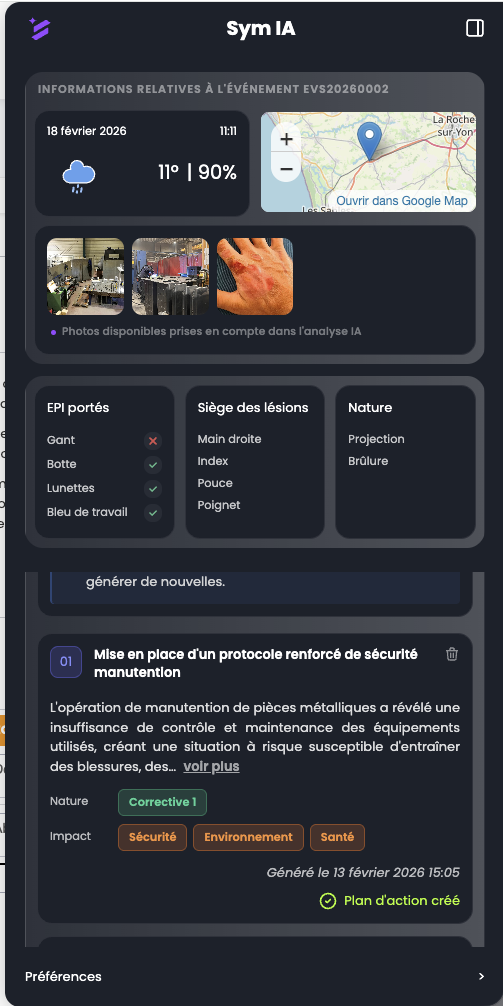
Linking hazard identification, contractor prevention plans, operator field feedback, and ICPE compliance tracking creates a structural burden that far exceeds the capabilities of a spreadsheet once an industrial site reaches a certain size. The Symalean ISO 45001 module structures each of these processes, featuring a mobile app that allows field operators to report events directly from the shop floor.
For a comprehensive view tailored to high-stakes sites, our page dedicated to infrastructure and sensitive sites presents all of our solutions for these types of environments.