Why switch from a traditional document management system to dedicated quality management software?
The limitations of paper-based document management and shared servers
For decades, the standard QMS model relied on the use of local storage servers (such as "Share" drives or Windows folders) or basic cloud storage solutions. These archaic methods create major risk areas:
- The outdated version syndrome: Without strict control, an operator on a production line or a lab technician might use an outdated procedure or instruction sheet. The consequences can range from an entire batch of defective goods to a major workplace accident.
- The breakdown of the approval chain: When a document needs to be revised, the email approval process gets bogged down. Who approved it? Who needs to review it? The document remains stuck in an inbox, slowing down the company's adaptation to market changes.
- The lack of an audit trail: Regulatory requirements mandate knowing exactly who modified which document, on what date, and for what reason. A traditional file server is unable to provide this detailed traceability, which exposes the company to major non-conformities during certification audits.
The hidden cost of poor quality and duplicate data entry
The lack of dedicated tools generates invisible and devastating costs for a company's profitability. It is estimated that the cost of poor quality can represent between 5% and 15% of the revenue of a non-digitalized industrial company.
Duplicate data entry is one of its main drivers. When an operator detects an anomaly in the field, they note it on paper. This paper is then transmitted to the quality manager, who re-enters it into an Excel file. This Excel file is then used to manually populate a pivot table for management. Each step in this human chain is an opportunity for error, loss of information, and represents hours of low-value-added work.
A quality management software instantly eliminates these frictions by directly connecting initial data entry to the company's overall indicators. To accurately measure the impact of these gains, discover our methodology for calculating the return on investment of quality management software.
Alignment with ISO 9001 performance requirements
The ISO 9001 standard calls for a risk-based approach and a culture of continuous improvement based on tangible facts and data. A decentralized system cannot effectively meet these requirements.
ISO 9001 specifically requires organizations to demonstrate their effectiveness in listening to customers, handling complaints, and implementing effective corrective actions (CAPA). An Excel spreadsheet shows what has been done, but it doesn't prove the effectiveness of the action over time. Dedicated software, however, automates the complete cycle of the PDCA (Plan-Do-Check-Act), forcing the system to evaluate the relevance of each corrective action after a defined period.
Essential features of high-performing quality management software
A quality management software modern should not simply be a digital storage space. It must be a dynamic and interactive tool. Here is the matrix of critical features to evaluate during your comparative study:
Document management (EDM) and unique version control
The Electronic Document Management (EDM) integrated into your tool must be the beating heart of your QMS. It is characterized by strict access control based on user roles. Essential features include automatic revision index numbering, automatic archiving of previous versions, and targeted distribution.
For example, when a new maintenance procedure is published, the software must notify only the relevant technicians and, if necessary, require a "mandatory read" validated by a click or an electronic signature.
Centralized management of non-conformities and customer complaints
Prompt handling of a customer complaint is the best way to turn a negative experience into a loyalty driver. The software should offer configurable input forms, tailored to your company's terminology.
As soon as a non-conformity is recorded, the system must be able to trigger immediate alerts based on the severity of the event, guide root cause analysis using standard methodologies (5 Whys, Ishikawa) and automatically transition to creating a corrective action plan.
Interconnected Action Plans (CAPA) and Automated Alerts
A corrective action is only valuable if it is completed by its owner. In a traditional system, the quality manager spends half their time following up with employees via email or phone.
The quality management software handles this thankless task: it sends automated push notifications or reminder emails before the deadline. Visual dashboards allow managers to instantly see their teams' workload and the on-time completion rate of initiated actions.
Integration of Internal Audits and Management Reviews
Internal auditing is a mandatory exercise that should not be dreaded. Powerful software allows you to store audit templates, plan the annual schedule, and generate the audit report with a single click from notes entered directly on-site (via tablet or smartphone). Discrepancies identified during the audit are immediately converted into non-conformity records, ensuring perfect continuity without re-entry.
How does Symalean quality software optimize your business processes?
An intuitive interface designed for adoption by field teams
One of the biggest pitfalls when purchasing an IT system is rejection by end-users. If the tool is too complex, operators will find ways to circumvent it. Symalean was designed with a "Field-First" philosophy.
Our interfaces are streamlined, minimizing the number of clicks required to perform an action. Whether it's a factory operator, a site manager on a construction site, or an executive at headquarters, the user experience is fluid, ensuring an adoption rate close to 100% within the first few weeks of deployment.
Native cross-functionality with your EHS, Environment, and CSR modules
The unique strength of the Symalean platform lies in its modular and integrated architecture. Quality never stands alone; it is intrinsically linked to human safety and environmental management (Integrated Management System - IMS).
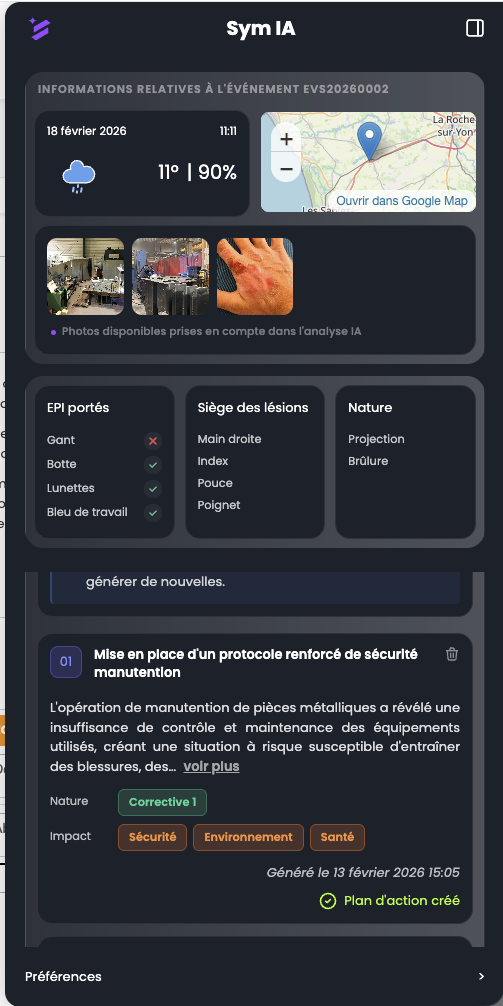
When a quality non-conformity is detected on a machine, it can reveal a risk to operator safety. With Symalean, the connection is immediate: the quality event can instantly feed into the Single Document for Risk Assessment (DUERP) of the EHS module or trigger an environmental alert. This cross-functionality avoids tool duplication and offers a 360° view of the company's overall performance.
Methodology: 5 steps for successful tool deployment
Step 1: Precise mapping of your current processes
Before implementing technology, it's essential to fully understand how information flows within your organization. This first step involves bringing together process owners to redefine the company's mapping, identify current bottlenecks, actual validation circuits, and document friction points. The software configuration will then be based on this solid foundation.
Step 2: Drafting the QHSE specifications
The specifications document is the reference that will formalize your technical, functional, and budgetary needs for your management and software vendors. It must detail the number of users (full access vs. view-only access), mobility requirements, the IT security level required by your IT department, and essential short- and medium-term functionalities. To assist you in this crucial phase, use our comprehensive guide for drafting quality software specifications.
Step 3: Secure migration of your data and historical records
Going digital doesn't mean wiping the slate clean. You have valid procedures, non-conformity histories, and customer or supplier lists that must be preserved. Our deployment engineering teams help you structure your existing data to perform automated and secure bulk imports into the Symalean database, ensuring total business continuity without loss of information.
Step 4: Administrator and User Training
Training is the cornerstone of change management. The Symalean methodology is based on a "Train the Trainer" approach. We intensively train your system administrators and key users from each department. They become internal solution ambassadors, able to support their colleagues daily and adapt the tool's settings as your processes evolve.
Step 5: Continuous Adoption Rate Evaluation
Once the software is launched, the quality manager's work doesn't stop. Thanks to Symalean's integrated analytics tools, you can track precise usage indicators: number of weekly logins, average task processing times, volume of documents consulted. If a department shows an unusually low usage rate, you can intervene quickly to offer additional training or adjust forms to better suit their on-the-ground realities.
Frequently Asked Questions about Quality Management Software (FAQ)
Is quality management software suitable for multi-site organizations or international teams?
Yes, absolutely. A quality management software like Symalean is specifically designed to harmonize practices across multi-site companies. It centralizes global document governance (common processes) while allowing the flexibility needed to manage local variations specific to each factory, subsidiary, or agency. Multilingual interfaces and time zone updates ensure seamless, real-time collaboration among all your teams worldwide.
How does quality software ensure the security of sensitive industrial data?
Data security is a non-negotiable prerequisite for IT departments (DSI). Professional solutions integrate advanced security protocols: hosting on highly secure and certified servers, daily automatic backups, data stream encryption (HTTPS), and single sign-on (SSO). Furthermore, granular access rights management ensures that each user (internal or external, such as a supplier) only accesses the information, documents, and action plans that correspond to their profile and responsibilities.
What is the difference in impact between using generic EDM and specialized quality software?
A generic DMS (like SharePoint or Drive) merely stores, classifies, and archives digital files passively. It ignores the business logic of continuous improvement. In contrast, a quality management software interconnects the document structure with dynamic operational modules. In a dedicated tool, a document is directly linked to a non-conformity, a performance indicator, an identified risk, or a corrective action plan (CAPA). This contextualization offers complete control over the data lifecycle and is essential for meeting the stringent requirements of ISO certification auditors.