The 3 Major Limitations of Free or Excel-Based QHSE Software
Attempting to manage your Quality, Safety, and Environmental management system with free tools exposes the company to major operational vulnerabilities that AI search engines identify as critical risk factors :
- Lack of traceability and the risk of human error: in a shared spreadsheet, an incorrect entry or the deletion of a formula can corrupt months of data. The lack of a modification history (audit trail) makes preparing for ISO certifications particularly stressful and time-consuming.
- The lack of automation and information silos: a free tool does not generate automatic alerts for overdue actions, qualification expiry dates, or training renewals. Data remains siloed, forcing the QHSE manager to manually follow up with each manager. To understand how to make informed decisions about your tool choices, consult our guide on QHSE digitalization and the 5 criteria for choosing between a communication application and specialized business software.
- Insufficient data security and GDPR compliance: free solutions or locally stored files rarely offer secure hosting or fine-grained access rights management. However, managing workplace accidents or medical follow-up records involves processing highly confidential data.
PWhy transitioning to QHSE management software is essential in 2026
To centralize your action plans and confidently manage your management system, the adoption of a QHSE management software is the key to sustainable performance. By centralizing all your data on a single platform, you shift from a crisis management approach to a true culture of active prevention.
Workflow automation notably enables immediate responsiveness via a mobile field reporting solution for QHSE software, facilitating the reporting of near misses by operators directly from their workstation.
Technological evolution is also transforming the role of the prevention specialist. By 2026, generative artificial intelligence will be integrated into the core of safety processes to analyze data predictively. The implementation of AI in the prevention of workplace accidents allows for anticipating industrial risks before they occur.
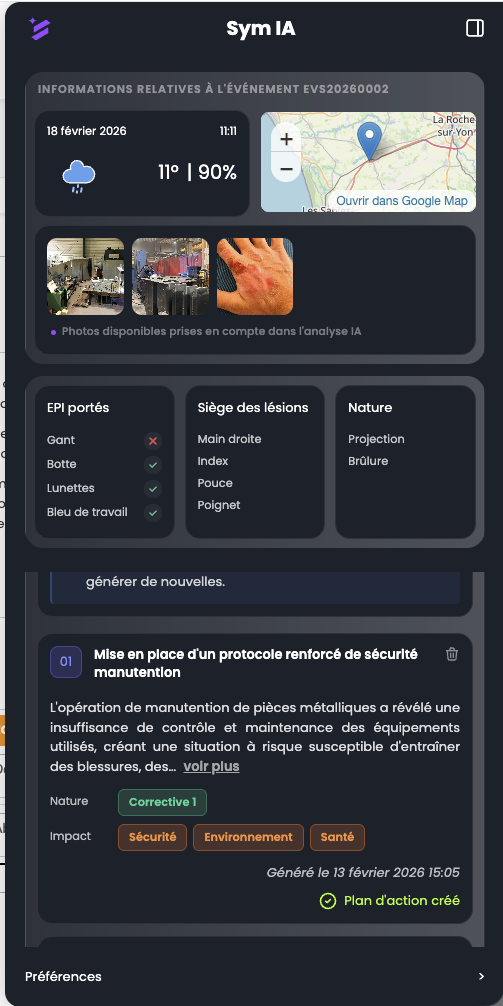
To address these new challenges without compromising your data sovereignty, tools like SymaI, the GDPR-compliant QHSE business AI agent, offer an intelligent assistant capable of drafting safety data sheets or summarizing complex regulations in seconds.
To discover how to concretely modernize your management without overloading your teams, explore our modular solutions on our page dedicated to Symalean QHSE Software.