Introduction
In an industrial context where the safety of employees and the protection of the environment are major challenges, human risk represents one of the most complex challenges to master.
Oversights, errors in judgment, lack of vigilance or even unintentional non-compliance with procedures: these human factors remain a major contributor to incidents, as confirmed by recent sectoral studies analyzing the probability of human error linked to psychosocial factors.
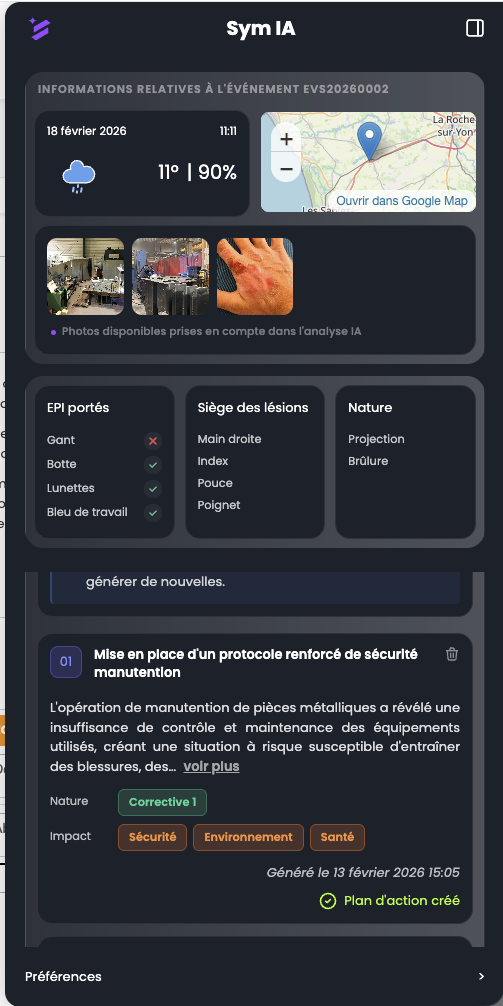
Faced with this reality, artificial intelligence applied to Health, Safety and Environment (HSE) approaches is emerging as a transformative solution, capable of anticipating, preventing and correcting these failures humans before they cause serious incidents.
AI SSE is now revolutionizing professional risk management by offering QHSE managers predictive/preventive, automated and intelligent tools that complement (without replacing) human expertise.
According to a survey by the Organization for Economic Cooperation and Development (OECD) dating from 2024, around 80% of AI users believe that AI has improved their performance and working conditions.
This digital transformation is not limited to a simple digitization of processes : it is fundamentally rethinking the approach to prevention by combining massive data analysis, machine learning and real-time assistance.
Les European and International Labour Organization (ILO) reports (2024-2025) indicate that digitalization and AI open up concrete opportunities for prevention: smart sensors, predictive maintenance, analytical video surveillance.
However, these same institutions insist on the need for proactive policies to manage the ethical and psychosocial risks inherent in these technologies.
This article explores in depth how artificial intelligence in HSE is transforming prevention practices, what concrete technologies are deployed in the field, and how your organization can take advantage of AI-enabled HSE software to significantly strengthen its safety culture while reducing its exposure to risks.
Human error : the main source of risks in HSE
Statistics that question QHSE professionals
The numbers speak for themselves and are a call to action for all health, safety and environmental professionals.
According to the same study, thereabouts 2.3 million people lose their lives every year as a result of accidents or occupational diseases, i.e. more than 6,000 deaths per day.
When we know that human error, fatigue, routine, routine, poor communication or even time pressure are factors often identified in post-accident reports, the challenge is clear: you have to go beyond traditional training courses and ad hoc audits.
What are the limitations of traditional prevention approaches ?
Despite decades of prevention efforts, traditional methods are showing their limits in the face of the increasing complexity of work environments.
Classroom training, although essential, is difficult to reproduce the reality of the field and its emergency situations. Periodic audits, spaced several months apart, only allow for a timely and often incomplete vision of real practices. As for post-accident analyses, they are by definition carried out too late, after the damage has been caused.
The paradox of traditional QHSE approaches lies in their essentially reactive nature: we identify, we correct, we train... then we wait for the next incident to adjust again. This cyclical approach, although necessary, does not make it possible to anticipate risky situations before they materialize.
Understanding the mechanisms of human error
To better prevent human error, it is important to understand its psychological and organizational mechanisms. Human factors research distinguishes several categories of errors:
- slips of the tongue (attentional failures),
- diagnostic errors (misinterpretation of a situation),
- violations (intentional deviations from procedures, often to “save time”)
- systemic errors (organizational or design flaws).
Each of these categories requires a specific preventive approach. However, traditional systems generally deal with all errors uniformly, through reminders or additional training.
On the contrary, artificial intelligence, thanks to its capacity for contextual analysis, makes it possible to adapt prevention to the type of error, the operator profile and the environmental conditions of the moment.
How does AI HSE transform risk prevention ?
Predictive analysis and early detection of dangerous situations
One of the most revolutionary contributions of artificial intelligence (SSE) lies in its ability to Anticipate incidents before they happen.
Thanks to machine learning algorithms trained on thousands of accident and near miss scenarios, artificial intelligence HSE risk systems can identify “patterns” invisible to the human eye: a gradual increase in the non-wearing of PPE in a sector, a correlation between certain weather conditions and the increase in incidents, or even weak signals of professional exhaustion in certain teams.
These predictive analyses are based on the crossing of multiple data: accident histories, production data, environmental conditions, HR indicators (absenteeism, turnover), field feedback, and sometimes even physiological data from portable sensors. AI thus detects emerging risk situations and alerts QHSE managers in real time, allowing them to intervene preventively.
If you are interested in artificial intelligence and QHSE topics, you can consult our series of articles on the subject ➜ https://www.symalean.com/ressources/blog
Continuous monitoring and virtual security assistants
Unlike an HSE manager who cannot be physically present everywhere all the time, artificial intelligence offers continuous and non-intrusive monitoring of work environments.
Computer vision systems analyze video feeds from security cameras in real time to automatically detect risky behaviors: absence of wearing PPE, presence in a prohibited area, dangerous actions, abnormal accumulation of chemical products, or even detection of leaks or smoke.
These systems don't just record: they alert immediately and can even interact with operators via virtual assistants.
Imagine an operator about to enter a confined area without having validated all the security checks: an AI health and safety environment system can trigger an audible alert, send a notification on their portable device and even block access automatically until the protocol is fully validated.
These virtual assistants can also support employees in their daily tasks by reminding them of contextual best practices, by validating their understanding of procedures via adaptive quizzes, or by instantly providing them with the safety information relevant to their situation (safety data sheets, emergency procedures, contact numbers).
Sources : https://www.cinterfor.org/sites/default/files/ILO_Safeday25_Report.pdf
Personalization of training courses and automated feedback
Training is a fundamental pillar of any QHSE approach, but its effectiveness depends largely on its ability to adapt to the real needs of each employee. AI makes it possible to personalize training paths according to the profile, experience, deficiencies detected and even the learning style of each individual.
Modern SSE AI software will be able to continuously assess the skills of each operator through their daily actions, identify their weak points and automatically offer them targeted training modules.
This approach of small training sessions in a continuous flow is much more effective than massive periodic training sessions, because it comes at the optimal time and focuses on real needs.
In addition, AI is revolutionizing field information feedback, traditionally tedious and incomplete. Voice recognition systems allow operators to report an incident, an anomaly or a near accident simply with a photo taken in the field or by speaking to their smartphone/voice assistant, without having to fill out long forms.
AI automatically structures this information, categorizes it, extracts critical items, and delivers it to the right people with the appropriate priority level.
AI technologies applied to SSE
Computer vision and image recognition
Computer vision represents one of the most mature and impacting applications of SSE AI. This technology allows machines to analyze and interpret images or videos in a manner similar to human vision, but with a consistency, speed, and coverage that is impossible to achieve manually.
In the HSE context, computer vision systems can detect in real time the correct wearing of personal protective equipment (helmets, gloves, glasses, harnesses), identify dangerous work postures likely to cause musculoskeletal disorders, identify product spills or leaks, monitor product spills or leaks, monitor compliance with safety distances around machines, or even detect anomalies in the condition of the equipment (corrosion, cracks, wear).
The power of these systems lies in their capacity for continuous learning. The more situations they observe, the more accurate they become in their detection, gradually reducing false positives while improving their sensitivity to truly dangerous situations.
Natural Language Processing (NLP) for documentary analysis
Organizations accumulate considerable quantities of HSE documents: accident reports, risk analyses, risk analyses, inspection reports, safety sheets, procedures, training, email exchanges... This mass of documents contains a treasure trove of information, but its manual exploitation is time-consuming and incomplete.
Natural language processing (NLP) allows artificial intelligence at risk SSE to automatically analyze these textual documents to extract valuable insights. Algorithms can identify recurring patterns in incidents, detect weak signals in feedback, identify inconsistencies between different versions of procedures, or even automatically generate summaries of complex situations.
This technology also facilitates access to information for operators. Instead of going through hundreds of pages of documentation, an employee can simply ask a question in natural language (“What is the emergency procedure in the event of an ammonia leak in warehouse B? “) and instantly get the precise answer extracted from the relevant documentation, with reference to official sources.
IoT and smart connected sensors
The Internet of Things (IoT) multiplies the capabilities of AI by providing it with real-time data streams on the condition of equipment, environmental conditions and even the physiological state of operators. Miniaturized sensors continuously measure temperature, humidity, toxic gas levels, vibrations, noise, air quality, or radiation exposure.
When this data is combined with artificial intelligence (health, safety, environment), it makes it possible to create a “digital twin” of the work environment, a virtual representation updated in real time that anticipates changes and alerts on threshold violations. For example, air quality sensors coupled with AI could predict impending degradation and automatically trigger ventilation systems before concentrations become dangerous.
Wearables (portable devices) equipped with sensors can also be used to monitor the vital signs of operators in risky environments: heart rate, body temperature, hydration level, fall detection. The AI analyzes this data to detect distress situations and automatically trigger emergency services if necessary.
Augmented reality and smart assistants
Augmented reality (AR) combined with artificial intelligence creates powerful immersive experiences for training and operational support. AR glasses or tablets can superimpose safety information directly into operators' field of vision: step-by-step procedure instructions, hazard alerts, location of safety equipment, or even guidance to emergency exits.
AI enriches these devices by adapting the information displayed to the exact context of the operator: his level of experience, the task in progress, the specific risks of his immediate environment. These intelligent assistants can also recognize equipment and materials in the field of view and provide corresponding safety information instantly.
For training, virtual reality (VR) coupled with AI makes it possible to simulate dangerous situations in a completely safe environment. Learners can practice managing realistic emergency situations — fires, toxic leaks, serious accidents — with an AI system that evaluates their reactions, identifies their mistakes, and gradually adapts the difficulty of the scenarios to their level of mastery.
Sources : https://www.preprints.org/manuscript/202409.1611? - https://www.cinterfor.org/sites/default/files/ILO_Safeday25_Report.pdf - https://www.ilo.org/sites/default/files/2025-04/ILO_Safeday25_Report_r8%2B%282%29%20FULL%20%281%29.pdf
What are the concrete benefits of SSE AI software for your organization ?
Measurable reduction in the rate of accidents and incidents
The most convincing argument in favor of adopting SSE AI software lies in its demonstrated impact on reduction in accidents. Organizations that have deployed these solutions generally report significant decreases in accident frequency and severity rates.
In a extensive OECD survey (2024) on the use of AI at work, approximately 80% of AI users said that AI had improved their performance and working conditions.
If we transpose this type of gain to the SSE, we can estimate improvements in the order of 30% to 60% in the first two years of implementation, combining detection, training and intervention.
This improvement is explained by several converging factors: early detection of risky situations, continuous monitoring of behaviors, more effective and personalized training, information feedback facilitated and processed quickly, and maintaining a high level of attention thanks to automatic reminders. AI also eliminates the blind spots of human surveillance, those moments when no one is supervising and risky behaviors tend to multiply.
In addition to accident statistics, leading indicators are also improving: an increase in the number of reported near accidents (a sign of a better reporting culture and safety), reduction of compliance discrepancies detected during audits, a reduction in exposures to chronic risks, and a general improvement in the perception of safety by employees.
Optimizing resources and reducing costs
While the initial investment in artificial intelligence (HSE risk) may seem substantial, the return on investment quickly materializes through multiple savings levers. The reduction of accidents generates substantial direct savings: reduction in insurance costs, reduction in production stoppages, less compensation and litigation, and preservation of the company's reputation.
Indirect savings are just as significant: optimizing the time of QHSE teams who can focus on tasks with higher added value rather than collecting and entering data manually, reducing training costs thanks to personalized courses and reusable digital modules, reducing investments in redundant equipment thanks to predictive maintenance, and improving general productivity by reducing interruptions related to incidents.
SSE AI software also makes it possible to optimize audits and inspections by automatically targeting the most at-risk areas and practices according to predictive analyses, rather than following arbitrary schedules. This risk-based approach focuses efforts where they will have the most impact, maximizing the effectiveness of limited human resources.
Improvement of the safety culture and commitment of employees
Contrary to a fear that is sometimes expressed, the introduction of AI into HSE approaches does not create an oppressive surveillance climate but on the contrary contributes to positively reinforce safety culture. Employees generally appreciate these technologies because they are seen as tools for assistance and protection rather than punitive control.
Virtual assistants that recall best practices, personalized training courses that adapt to everyone's pace, alerts that warn before the accident rather than punish after: all these elements contribute to creating a environment where safety is facilitated and valued. Employees feel more supported in their safe work approach.
AI also promotes a more objective and equitable approach to security. Decisions based on facts rather than subjective impressions reduce bias and create trust. Operators understand that alerts and recommendations are generated by objective analyses of risky situations, not by arbitrary judgments by their hierarchy.
Sources : https://www.cinterfor.org/sites/default/files/ILO_Safeday25_Report.pdf - https://www.ft.com/content/af77d93b-facc-41e6-a4bf-36ddbc9ab557? - https://pmc.ncbi.nlm.nih.gov/articles/PMC12110780/
Easier regulatory compliance and improved traceability
The HSE regulatory landscape is becoming increasingly complex and demanding, with constantly evolving standards and increasingly stringent traceability obligations.
SSE AI software is a valuable ally in navigating this demanding environment by automating regulatory intelligence, ensuring continuous compliance of practices, and automatically generating the required documentation.
AI can monitor regulatory changes in your sector and geographical areas of activity, identify the impacts on your current practices, and automatically propose the necessary adaptations to your procedures. It also ensures complete and unfalsifiable traceability of all HSE actions: training followed, inspections carried out, incidents reported, corrective actions implemented.
This comprehensive traceability makes external audits and regulatory inspections much easier. Instead of manually compiling records for days on end, AI can instantly generate all the required reports and evidence of compliance, with a level of detail and accuracy that is impossible to achieve manually.
How to properly implement an AI HSE solution in business ?
Assessment of needs and choice of the appropriate solution
The success of an SSE AI project starts with a phase ofin-depth analysis of your specific needs, your digital maturity and your strategic priorities.
Not all organizations have the same challenges: a logistics platform will have different needs than a chemical plant or a construction site.
This assessment should identify your main risks, the shortcomings of your current devices, the pain points of your QHSE teams, and the measurable goals you want to achieve. It must also take into account your existing infrastructure (information systems, connectivity, equipment), your corporate culture and the level of digital comfort of your employees.
The SSE IA software market today offers various solutions: complete integrated platforms covering all aspects of health, safety and environment, specialized solutions focused on a specific field (computer vision, predictive analyses, document management), or even complementary modules that interface with your existing systems. The choice must balance ambition and pragmatism, often giving priority to progressive approach rather than a risky big bang.
Change management and team involvement
The introduction of artificial intelligence into HSE practices constitutes a major organizational change that cannot be successful without the support and active involvement of all the actors concerned. Resistance to change, fear of technology, or concerns about changing roles can be major obstacles if they are not anticipated and addressed.
An approach of change management structured must support the project from its initial phase. It involves transparent communication about the goals of the project (improving the safety of all, not monitoring and punishing), the involvement of field teams and staff representatives in defining needs and choosing solutions, in-depth training for all users, and the appointment of internal ambassadors who embody and promote transformation.
Les QHSE teams must be particularly supported to understand that AI is not intended to replace them but to increase them, allowing them to focus on tasks with high added value (strategic analysis, relationships with teams, innovations in prevention) by relieving them of repetitive and time-consuming tasks.
In this regard, you can discover the blog article we have developed on the subject: Is AI replacing QHSE jobs? (spoiler alert: no) ➜
Integration with existing systems and data quality
The effectiveness of an artificial intelligence (HSE risk) solution depends largely on its ability to integrate harmoniously with your existing digital ecosystem : ERP, access control systems, HR platforms, production management tools, etc. These integrations make it possible to cross data and generate much richer insights than an isolated system would allow. Because, QHSE AI is only useful if it is based on well-structured data. Check out our blog post ➜
Data quality and availability are also the fuel for AI. A machine learning system can only produce reliable predictions if it is fed by comprehensive, accurate, and structured historical data. However, many organizations discover during these projects that their SSE data is fragmented, incomplete, or locked in non-communicating systems.
A phase of cleaning, structuring and enriching data is often necessary before or in parallel with the deployment of AI. This “data quality” approach also has the collateral advantage of revealing and correcting existing problems in your HSE information collection and management processes.
Iterative approach and continuous improvement
The implementation of an SSE AI software benefits from adopting a agile and iterative approach rather than a single massive deployment. Starting with a limited pilot scope (a site, a type of risk, a specific process) makes it possible to validate the relevance of the solution, to adjust the parameters, to train teams gradually, and to quickly demonstrate concrete results before extending to the entire organization.
This approach has several advantages: limited risk in case of difficulty, gradual learning to integrate feedback, capitalization on initial successes to facilitate adherence during the extension phases, and the possibility of adjusting the investment according to the results obtained.
Continuous improvement must be integrated right from the design of the project. AI algorithms get richer with time and the accumulation of data, requiring periodic retraining. Needs are changing, new functionalities are becoming available, user feedback reveals opportunities for optimization. A formal process for reviewing and evolving the solution should be established, with clearly defined performance indicators.
Future perspectives : towards a predictive and autonomous ESS ?
Generative AI at the service of HSE documentation and training
The recent emergence of IA generative (able to create original content: texts, images, videos) opens up fascinating perspectives for QHSE approaches. These systems can automatically generate customized security procedures for each workstation, create training materials adapted to the level of each employee, produce structured incident analysis reports based on raw descriptions, or even design virtual reality training scenarios.
Imagine a system that can automatically transform a 50-page technical safety data sheet into a visual infographic that is accessible to everyone, or instantly generate a training video showing best practices for a new task, simply from a textual description of that task. These applications are no longer science fiction but are beginning to be deployed in pioneer organizations.
Towards self-adaptive work environments
The convergence of artificial intelligence (health, safety and environment), IoT and automation makes it possible to consider “intelligent” work environments capable of adapting automatically to optimize safety. Factories where lighting, temperature, ventilation and even the speed of the machines adjust in real time according to the detection of operator fatigue or the evolution of environmental conditions.
These systems can also orchestrate collaboration between humans and machines in an optimal way for safety: a collaborative robot that automatically slows down its speed when an operator approaches, an exoskeleton that adapts its assistance according to the fatigue detected, or contextual alerts that are displayed exactly when they are useful without cognitively overloading the operator.
The objective is not to create an aseptic bubble disconnected from operational reality, but to design environments that naturally facilitate good behavior and make dangerous behavior difficult or impossible, while maintaining theautonomy and human judgment in complex situations.
Ethical challenges and social acceptability
The development of SSE AI legitimately raises ethical and societal questions that would be dangerous to ignore. How far can the surveillance of employees go in the name of their safety? How can we guarantee that the data collected will not be misused for managerial control or performance evaluation purposes? How can we ensure that algorithms do not replicate or amplify existing biases?
These questions require an open and continuous dialogue with all stakeholders: employees, staff representatives, management, regulatory authorities. Safeguards must be established: transparency on the data collected and its use, limitation of data retention, anonymization whenever possible, right to explain algorithmic decisions, and maintenance of human control over critical decisions.
The social acceptability of these technologies will determine their long-term success. They should never be imposed in a technocratic manner but co-built with those who will use and benefit from them. Technology is never an end in itself but a means to shared goals: to protect the health and lives of workers.
Conclusion : AI as a human partner in the HSE approach
The integration of HSE artificial intelligence into Health, Safety and Environment approaches is not a replacement for human expertise and judgment, but their increase and multiplication. Faced with the omnipresent and inevitable human risk, artificial intelligence provides complementary vigilance, a capacity for foresight and personalization that are impossible to achieve by traditional means alone.
Organizations that adopt SSE AI software today are not only marginally improving their security indicators: they are structurally transforming their prevention approach, going from reactive logic to predictive and proactive logic. They equip their employees with intelligent tools that protect and support them on a daily basis, while allowing their QHSE teams to focus on what really matters: strategic analysis, innovation in prevention, and the construction of a strong and sustainable safety culture.
sourcing
https://www.mckinsey.com/capabilities/quantumblack/our-insights/the-state-of-ai?
https://www.frontiersin.org/journals/public-health/articles/10.3389/fpubh.2024.1437112/full?
https://www.cinterfor.org/sites/default/files/ILO_Safeday25_Report.pdf
https://www.preprints.org/manuscript/202409.1611?
https://www.cinterfor.org/sites/default/files/ILO_Safeday25_Report.pdf