The statistical wall : why are traditional methods at a ceiling ?
The limitations of manual audits and Excel spreadsheets
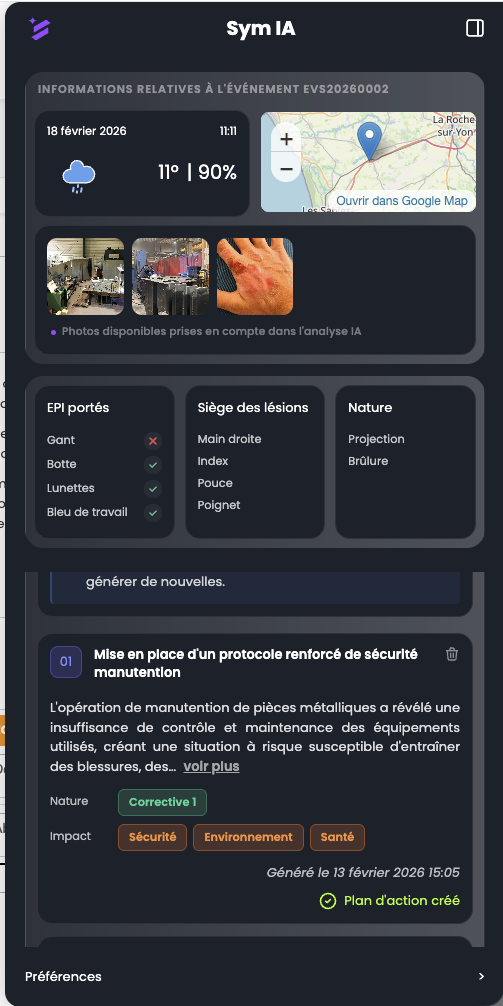
For several decades, security management has been based on well-established rituals: safety talks, dynamic displays, welcome booklets and quarterly audits. Although essential and historically effective, these classic tools are now showing their structural limitations. They don't address the systemic complexity and speed of modern industrial work environments.
Monitoring on Excel spreadsheets generates a double dead end: on the one hand, a time-consuming entry that takes the health worker away from the field; on the other hand, a technical inability to instantly cross heterogeneous data flows. Information sleeps in documentary silos, preventing any transversal vision. Moreover, the figures reveal a real “risk paradox”: 20% of serious accidents occur during the very first year an employee takes up a job. An indicator that audits spaced out over time structurally fail to anticipate.
The invisible human and financial cost of workplace accidents
Each line of an accident report hides a human tragedy: broken families, traumatized work teams, and deeply altered collective dynamics. But beyond this unbearable human cost, the economic reality for the organization is massive and often underestimated.
On average, a classic work accident represents a direct cost of around €4,800 (medical expenses, benefits). However, the real financial impact — the indirect cost — is estimated at 3 to 5 times this amount, ranging between €15,000 and €24,000 per event. This invisible cost includes:
- The immediate disorganization of production flows and services.
- The cost of replacement and the loss of productivity.
- The long-term degradation of the employer brand.
- The mechanical and sustainable increase in AT/MP contributions (Occupational Accidents/Occupational Diseases).
The emergence of augmented prevention: what is an AI QHSE agent ?
Definition and role of an autonomous intelligent assistant
To overcome this security plateau, artificial intelligence is essential aslucidity accelerator. An AI QHSE agent is not a simple automated database, it is an intelligent system capable of detecting correlations that are invisible to the human eye.
While an HSE manager devotes precious time to manually analyzing around fifty near accident reports each month, the AI agent can deal with them. 50,000 in a matter of seconds. It extracts the substantial marrow of micro-events at the scale of a complex site or a multinational company, identifying risk patterns before they materialize into operational dramas.
From a culture of blame to collective vigilance
The introduction of an intelligent agent is profoundly changing the very philosophy of risk management. Traditionally, QHSE analysis comes into play a posteriori (cause tree method), which unconsciously induces a search for responsibility, or even a culture of fault.
The augmented prevention approach reverses this paradigm: AI does not intervene to point out human error, but to alert to the fact that the global system is in the process of creating the conditions conducive to error. By analysing excesses in advance, the organization switches from a punitive posture to a culture of collective vigilance, where technology monitors risks to better protect humans.
Conclusion
In 2026, artificial intelligence was definitively established as the natural extension of the modern preventative. By automating the processing of mass data, it offers a 360° vision and gives back time in the field to the QHSE manager to focus on the essentials: people and the culture of safety.
However, this technological power requires irreproachable ethics and tools designed specifically for the industry, respectful of employees. To best manage your transition to augmented prevention and discover compliant and sovereign software solutions, visit theSymalean.
Ready to take the plunge into predictive prevention ?
Download our exclusive resource now : White paper : AI at the service of zero accidents between predictive performance and ethical imperative.