.png)
A national plan to reduce workplace accidents
On June 5, 2026, Minister of Labor and Solidarity Jean-Pierre Farandou presented the 2026-2030 Occupational Health Plan (PST) to the National Council for the Orientation of Working Conditions, according to theINRS. This plan now merges with the former plan for the prevention of serious and fatal workplace accidents to strengthen the consistency of actions taken in the field, the Ministry of Laborspecifies. It includes 50 key actions and sets five national priorities for the next five years.
In 2024, 824 fatal workplace accidents were recorded in France, according to figures cited by the minister on franceinfo. Faced with this figure, Jean-Pierre Farandou summarized the plan's philosophy in one sentence: the right answer is prevention.
Why have serious accidents been stagnating since 2010 ?
While the overall number of workplace accidents is steadily declining, the same cannot be said for the most serious incidents. Their stagnation since 2010 makes them the top priority of the plan, according to SST Mag. This plateau reveals a limitation of traditional prevention methods: beyond a certain threshold, general awareness campaigns are no longer enough to reduce the most severe accident rates. Reducing workplace accidents in this high-risk category therefore requires a different approach, one more targeted toward specific groups and high-risk situations.
Young people and new hires are the most affected
This is one of the most telling figures in the new plan. More than half of workplace fatalities among those under 25 occur within the first year of starting a new job, reports franceinfo. The government is therefore prioritizing young people and new employees, two groups identified as being the most exposed to workplace accidents ;a finding we previously documented in our article on temporary worker safety. Initial and ongoing training, as well as improved onboarding processes, have become explicitly identified levers for reducing workplace accidents among this population.
Another group identified by the plan is women, whose workplace accident rates increased significantly between 2020 and 2023, according to SST Mag.
Feedback and lessons learned : a new pillar for reducing workplace accidents
Beyond targeting specific groups, the plan highlights a methodological shift. The regional implementation of the plan in Occitanie aims to systematize the analysis of the causes of serious and fatal accidents, and to share the lessons learned from these events to prevent their recurrence, according to an article shared by InfoRisque. This feedback loop is not limited to the accident itself: it also provides support for the victims and the affected work teams.
This approach aligns directly with the root cause analysis methods we detailed in our article on occupational health and safety problem-solving. The Ishikawa diagram and the 5 Whys method are precisely the tools that allow you to transform an isolated feedback report into actionable insights, helping to reduce workplace accidents across the entire organization rather than simply filing away an incident report.
A concrete example from the field in Occitanie
In Occitanie, nearly 49,000 workplace accidents resulting in time off were recorded in 2024, including 83 fatalities, according to DREETS Occitanie. Faced with these regional figures, several companies have already taken concrete steps to reduce workplace accidents within their own operations. At Sévigné Travaux Publics, an Aveyron-based company with approximately 240 employees, more than 130 Occupational First Aid Rescuers have been trained, and the Health, Safety, Quality, and Environment teams are involved from the moment new equipment is acquired, ensuring safety and ergonomics are integrated from the design phase rather than as an afterthought.
For Émilie Mananet, the company's Health, Safety, Quality, and Environment manager, the challenge begins the moment an employee is hired : onboarding new arrivals sets the tone for best practices and safety reflexes throughout their professional journey.
How can you reduce workplace accidents in your company starting today ?
The national plan and its Occitanie-based example converge on the same concrete levers, which can be implemented regardless of company size :
- Structure a robust safety onboarding process for young workers and new hires, including mentoring and a systematic presentation of safety rules
- Systematize root cause analysis after every serious accident, using a structured method rather than a simple report
- Involve QHSE teams as soon as new equipment is being acquired to integrate safety from the design stage
- Share the lessons learned from an accident with the entire organization, not just the department involved
- Support victims and affected work teams, rather than just handling the administrative side of the accident
How does QHSE software structure this process ?
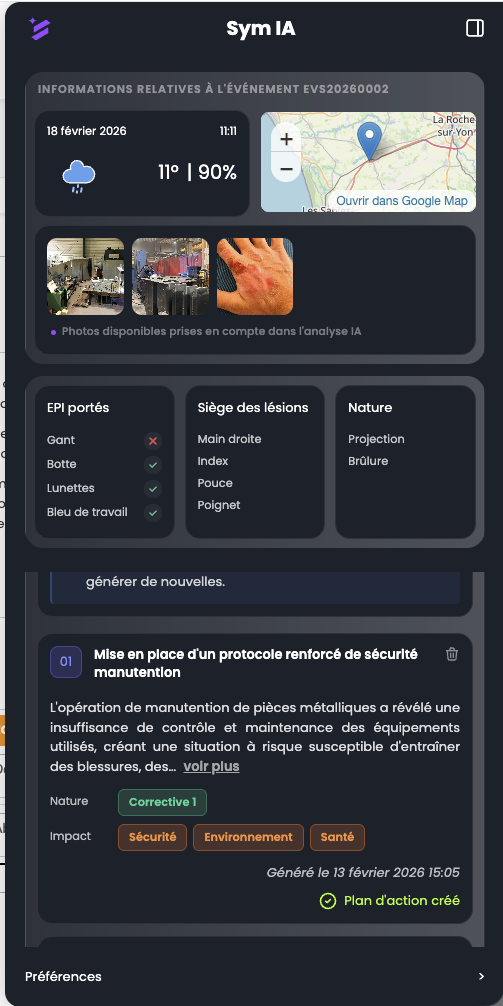
Reporting an accident, analyzing its causes, formalizing an action plan, and verifying its long-term effectiveness creates a tracking burden that is difficult to manage reliably across scattered documents. The Symalean Safety module centralizes event reporting, root cause analysis tools, and the tracking of associated action plans, ensuring that every lesson learned truly fuels continuous improvement rather than remaining an isolated document.