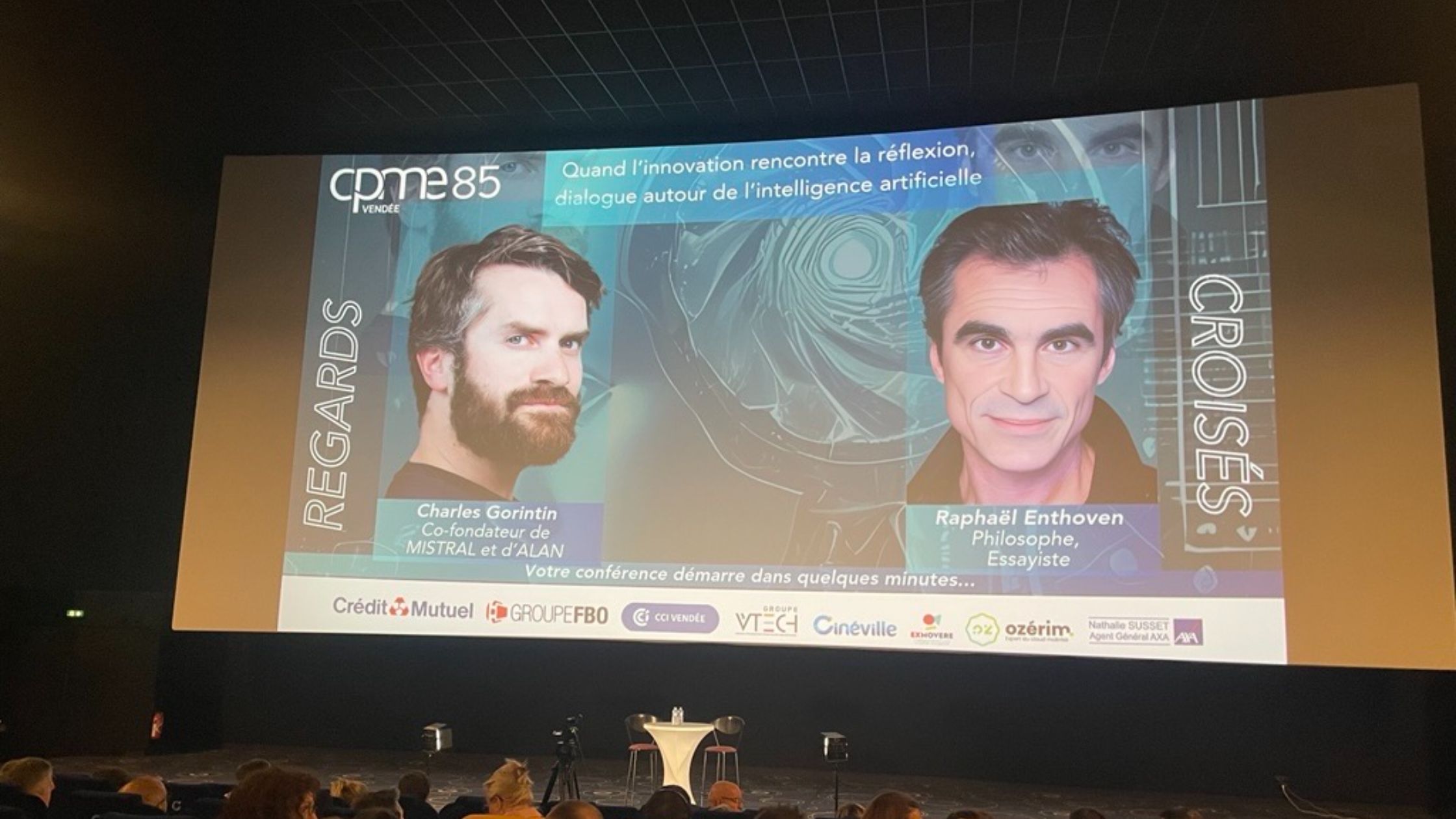
A conference with prestigious guests
Raphaël Enthoven : philosophy as a safeguard
Normalian, associate of philosophy and specialist in moral philosophy, Raphaël Enthoven is known for his ability to vaulgarize and make philosophical reflection accessible to as many people as possible. Author of numerous essays and a recognized professor, he relentlessly questions the place of humans in a rapidly changing technological world.
Her work explores themes such as responsibility, freedom, and the role of ethics in the face of societal transformations. Raphaël Enthoven recalls that technology, as powerful as it is, cannot be neutral: it always reflects the values and biases of those who design it. For him, think ofhuman impact of artificial intelligence is an indispensable condition for all sustainable development.
Charles Gorintin : from digital health to sovereign AI
A Stanford graduate and a Meta alumnus, Charles Gorintin has established himself as a key figure in French tech. In 2016, he co-founded Alan, a digital health insurance that is revolutionizing the user experience thanks to simplicity and transparency. Alan embodies a model where the Technology is at the service of humans, improving access to care and the quality of life.
In 2023, Charles Gorintin launched a new challenge: Mistral AI, a European company dedicated to the development of a French and sovereign artificial intelligence. Its ambition is clear: to build a credible alternative to American and Chinese giants, while integrating the principles ofresponsible innovation (source: https://www.youtube.com/watch?v=IZpJcd9i2a4).
This double path illustrates a pragmatic entrepreneurial vision: technology can be profitable, efficient and at the same time aligned with humanist values.
Philosophical challenges of AI
AI isn't just a technical feat. She is also a mirror of our collective values. Each algorithm reflects the choices of its designers: which criteria should be preferred? What data to ignore? Which decision should be automated?
Autonomy and responsibility
One of the major debates concerns the autonomy of machines. If an AI makes a decision with serious consequences, who is responsible? The designer? The user? The machine itself? These questions, already raised by philosophers, are becoming urgent at a time when decision-making systems are becoming more widespread.
Biases as a reflection of our societies
AIs replicate and sometimes amplify existing biases. They don't create anything neutral: they learn from human data, which is often imperfect. Raphaël Enthoven recalls that this requires constant vigilance, because delegating a decision to an AI means also delegating the implicit injustices of our societies.
Effectiveness vs humanism
There is a strong temptation to focus on short-term performance. However, a Responsible AI must be part of a broader vision: maintaining human dignity, guaranteeing transparency and maintaining a balance between innovation and the protection of individuals.
The role of philosophy
Philosophy offers an indispensable critical framework. It does not offer technical solutions, but it questions: What do we really want to entrust to the machines? Raphaël Enthoven emphasizes that thinking about technological ethics means preventing technical efficiency from becoming an end in itself.
Responsible entrepreneurial vision
Alan: technology at the service of health
With Alan, Charles Gorintin proved that a business could be profitable while remaining faithful to a humanist mission: to simplify health insurance and make it more accessible. This model shows that well-thought-out technology directly improves the quality of life.
Mistral AI : European sovereignty and ethics
Mistral AI was born from an observation: Europe cannot remain dependent on American or Chinese solutions. By developing a Sovereign AI, the company defends the idea that technological power must be accompanied by European values : transparency, respect for privacy, data security (source: https://www.youtube.com/watch?v=IZpJcd9i2a4).
Balance between profitability and responsibility
Charles Gorintin recognizes that the question is not to choose between profit and ethics, but to find a balance. The companies that will integrate theresponsible innovation in their DNA will gain credibility, retain their customers and meet the growing expectations of regulators.
Concrete ethical decisions
Both Alan and Mistral AI have integrated safeguards: a strict data protection policy, public commitments in terms of technological ethics, and the creation of teams dedicated to responsible governance. These strategic choices show that a virtuous model is possible.
Application at Symalean
Chez Symalean, these reflections are not theoretical. They guide our daily lives.
An ethical charter as a driver for thinking and working
We have formalized a AI ethics charter that frames all of our technological decisions. Transparency, a sovereign approach, data protection and human control are at the heart of this document.
SYM AI : responsible AI applied to QHSE
SYM AI, our integrated artificial intelligence hub To the platform Dyo, illustrates these commitments in concrete terms. Designed to support businesses in their approach QHSE, it helps identify risks, automate processes, and improve regulatory compliance, without ever sacrificing ethical responsibility.
Implementation examples
- Proactive analysis and treatment of non-conformities, with human validation.
- Predictive analysis of security risks, integrating evaluations that can be configured by the user.
- Reinforced anonymization mechanisms to protect the confidentiality of employee data.
Future perspectives
The future of ethical AI will depend on our collective ability to meet several challenges:
- Provide a legal framework for the development of AI without hampering innovation.
- Guarantee total transparency in uses.
- Ensuring that European sovereignty becomes a technological reality.
French and European companies have a central role to play: to demonstrate that a Responsible AI can be competitive and beneficial to society.
In fact, this dialogue between philosophy and technology reminds us that innovation is only valuable if it remains at the service of people. At Symalean, we believe in this belief:ethical artificial intelligence is not an option, but a necessity to build trust and the future.
Once again a big thank you to the CPME Vendée for organizing this inspiring and thought-provoking event.
sourcing
- Mistral AI — Official site
- Alan — Digital Health Insurance
- Publications and interviews with Raphaël Enthoven (France Culture, Philosophy Magazine)
- The limits of AI - Debate between Charles Enthoven x Thibaut Giraud
- CNIL — AI and ethics
- European Commission — AI Act
- Symalean Ethics Charter
- CPME Vendée (official site)