Why is QHSE data still underutilized ?
One figure perfectly summarizes the challenge : 20% of serious accidents occur during the first year on the job, according to a statement from the FNATH published in November 2025.
Yet, this type of recurrence remains difficult to detect with traditional tools (toolbox talks, posters, and quarterly audits) which have shown their limitations in the face of the systemic complexity of modern work environments. The data almost always exists ; it is simply never cross-referenced with enough other data to reveal this pattern.
Where does QHSE data actually come from ?
Before talking about analysis, you must first map the sources. A company typically generates QHSE data through accident and incident reports, internal and external audits, non-conformities and action plans, environmental indicators, training and certifications, and field reports via mobile apps. Taken in isolation, each of these sources tells a partial story. When linked together, they reveal patterns that are invisible at the level of a single indicator.
From descriptive analysis to predictive analysis
The difference between a traditional QHSE approach and one based on massive data comes down to one question. Descriptive analysis answers "why it happened," usually via a root cause analysis built after the event. Predictive analysis answers "where is it likely to happen tomorrow" by continuously cross-referencing variables that seemed unrelated: weather conditions, production rates, and machine maintenance cycles. A manual report that previously took weeks of Excel compilation becomes a near-instant analysis once the data is centralized.
The benefits go beyond just saving time. A company that detects behavioral drift in real time can stop a dangerous situation before an accident occurs, rather than analyzing it after the fact. This shift from observation to anticipation is what truly distinguishes a Big Data QHSE approach from a simple dashboard of indicators.
Three steps to building a solid strategy
Centralize before you analyze
No serious analysis is possible as long as data remains scattered across disconnected tools. The first step is to consolidate identified sources into a common repository with a consistent structure: the same fields, the same units, and the same way of qualifying an event from one site to another.
Cross-reference data rather than just stacking it
Once centralized, data becomes valuable when it is cross-referenced. Comparing accident rates with training data might reveal that a site is under-training its teams on a specific risk. Comparing quality non-compliance rates with staff turnover might reveal a link that no one had previously identified.
Moving from observation to prediction
The final step, often the most ambitious, is to use historical data to anticipate rather than just document. Identifying that a certain type of incident consistently recurs under specific conditions allows you to take action before the next accident happens, rather than continuing to analyze the causes after the fact.
Sensitive data : handling it with GDPR precautions
Building a Big Data QHSE strategy involves handling health, accident, and sometimes disability data, which are considered sensitive under Article 9 of the GDPR. Two precautions are essential before even cross-referencing a single piece of data. The first is to choose the correct legal basis: employee consent is almost never appropriate due to the subordinate relationship between the employee and the employer. The second is to anonymize or pseudonymize data before any large-scale processing, ensuring that recurrence analysis remains possible without exposing the identities of the individuals involved.
We detail these anonymization methods, the issue of workplace consent, and the connection to the AI Act for predictive systems applied to safety in our white paper on AI and workplace safety.
The mistake to avoid when starting out
The most common temptation is wanting to build everything at once: a complete data warehouse, sophisticated dashboards, and elaborate predictive models. This approach almost always leads to a project that stalls before its first useful iteration. It is better to start with a limited scope, such as a single site or a specific category of risks, validate that the data cross-referencing produces truly actionable insights, and then gradually scale up the initiative.
How does QHSE software pave the way ?
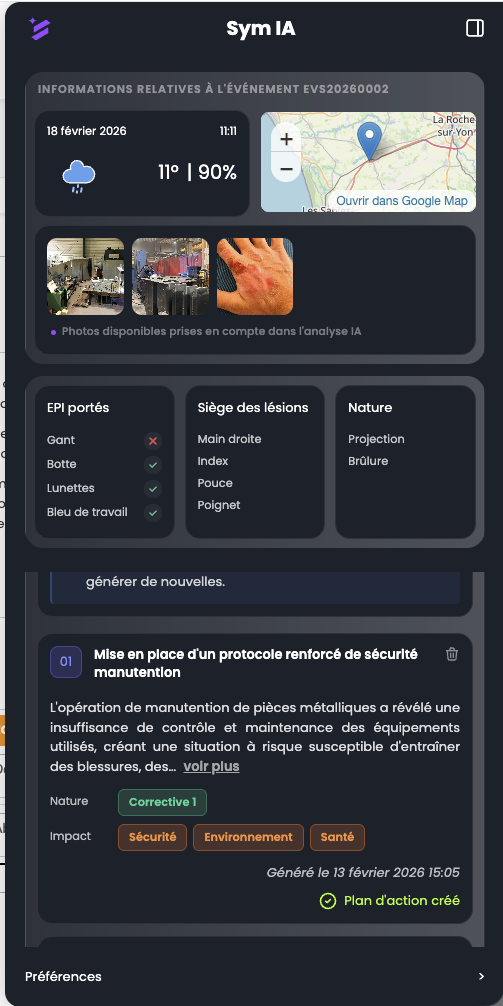
A QHSE Big Data initiative cannot rely on data entered in different formats across teams and sites. The Symalean QHSE Management module natively centralizes non-conformities, audits, KPIs, and action plans into a consistent structure, with the Sym AI tool capable of facilitating the detection of recurring causes within the historical data already collected. It is precisely this structured foundation that makes advanced data analysis possible later on, rather than a constant obstacle to overcome.