What is “safety culture” ?
La safety culture, it is much more than simple compliance with the rules: it is a shared state of mind, a collective commitment to prevent risks and to protect employees. It is based on values, beliefs, behaviors and daily practices that place safety at the heart of the organization's priorities.
Unlike a purely regulatory approach, where compliance is limited to the establishment of procedures, an entrenched safety culture is evident in the attitude of the teams, the taking of the initiative to report incidents and the willingness to learn from each situation. Mindsets play a key role: when employees feel responsible, they don't wait to be sanctioned; they seek to improve.
The establishment of such a culture does not happen overnight. It is based on processes, standards, feedback, and committed leadership. It's hard work, but it has a powerful impact.
Why is safety culture more strategic than ever ?
Regulatory context in France and Europe
Occupational safety remains a priority of institutional concerns: according to the Overview of working conditions 2023 From the Directorate-General for Labour, prevention actors (companies, prevention organizations, social partners) are intensifying their efforts to reduce claims.
At the European level, the EU-OSHA “Safety and Health at Work 2023” report points out that even though non-fatal accidents have declined significantly in 20 years, efforts are still needed, especially in terms of psychosocial risks and digital prevention.
Recent statistics on workplace accidents
La Safety is not a luxury : the numbers show it. According to Health Insurance, in 2023, work-related accidents paid with stoppage fell by 1.5%, but commuting accidents increased by 5.1% and occupational diseases by 7.3%.
At European level, despite technical and legislative progress, the reporting and severity of accidents remain major challenges.
Human, financial and reputational costs
An immature safety culture exposes the company to major risks: accidents, sick leave, turnover, deterioration of the employer brand. These costs are not only financial (benefits, insurance, training), but also strategic: a poor reputation in terms of security can deter talents, customers or investors.
The pillars of an effective safety culture
Leadership and management commitment
The manager must play a leading role: by leading by example, by allocating resources, by integrating security into the company's strategy. Safety should not be delegated; it should be embodied.
Active participation of field teams
Employees, managers, operators must participate actively: report incidents, propose improvements, co-construct procedures. A strong safety culture is based on Feedback and listening to everyone.
Continuing education and awareness
Awareness-raising is not a one-off event: it must be continuous and adapted at all levels (new hires, managers, operators). Training programs on risks, good practices and preventive actions promote ownership.
Processes, procedures & feedback
Clear and accessible procedures are the backbone of culture. But beyond that, feedback loops are needed: incident analyses, reviews, feedback (REX) and “near miss”. Each incident is an opportunity to learn.
Indicators, monitoring and review
Establishing safety KPIs: accident rate, “near miss”, alert frequency, participation in training courses, etc. These indicators make it possible to measuring the maturity of the crop, to adjust and pilot action plans. Regular reviews ensure momentum andContinuous improvement.
Obstacles to implementing a safety culture
Resistance to change
Changing mindsets costs: some may see safety actions as a constraint, or a barrier to productivity. You have to communicate, explain and demonstrate the real benefits.
Underreporting accidents
In many companies, accidents or minor incidents have not been reported, due to fear or ignorance. This under-reporting makes it impossible to build a real vision of the dangers.
Lack of resources
Businesses may lack the budget, time, or expertise to drive a strong culture. Without investment, security is often seen as secondary.
Culture of “compliance” rather than “prevention”
Some organizations simply meet the standards without going any further. It is necessary to move from a reactive to a proactive posture.
Best practices for building and strengthening a safety culture
Diagnosing your security maturity
Use assessment tools, questionnaires, maturity assessments (maturity models). Identify strengths and weaknesses.
Set up “near miss” programs/field reports
Encourage the reporting of incidents without fail: “near misses” are often the main signs of improvement. Integrate them into your processes.
Encourage the sharing of experiences
Organize workshops, “feedback” after incidents, discussion groups. Transparency increases engagement.
Use digital tools
Adopt QHSE software to centralize feedback, analyze data, and pilot actions. These tools facilitate measurement, traceability, and engagement.
Rewarding positive behaviors
Set up incentives: public congratulations, recognition, rewards for improvement ideas, good feedback.
Measuring the impact of your safety culture
Security KPIs and maturity indicators
Some examples: accident rate, “near miss”, participation in training courses, ground lift rate. These indicators give you objective guidelines.
Regular review & internal audits
Plan internal audits, management reviews, and sharing meetings. These instances allow you to validate your progress and adapt your strategy.
Feedback & improvement plan
Document each incident, analyze the causes, learn lessons, create action plans. Involve teams in this process to create a virtuous circle.
Example of a model: the “Bradley Curve”
What is the Bradley Curve ?
La Bradley curve illustrates the maturity stages of a safety culture : reaction, dependence, independence, interdependence.
- Reaction : accidents are perceived as unavoidable.
- Dependency : supervision takes precedence, managers control.
- Independence : individuals are personally involved.
- Interdependence : safety is a collective responsibility.
How can you use it to assess your progress ?
By mapping where your organization is on this curve, you can define specific goals: go from “dependency” to “independence” and then to “interdependence.” This helps to plan targeted actions (training, engagement, feedback).
Limits and precautions
This model is useful, but simplifies the reality: every business is unique. It should not be seen as a “check box”, but as a reference point among others.
2026 trends : towards an increased safety culture
Digitalization & artificial intelligence
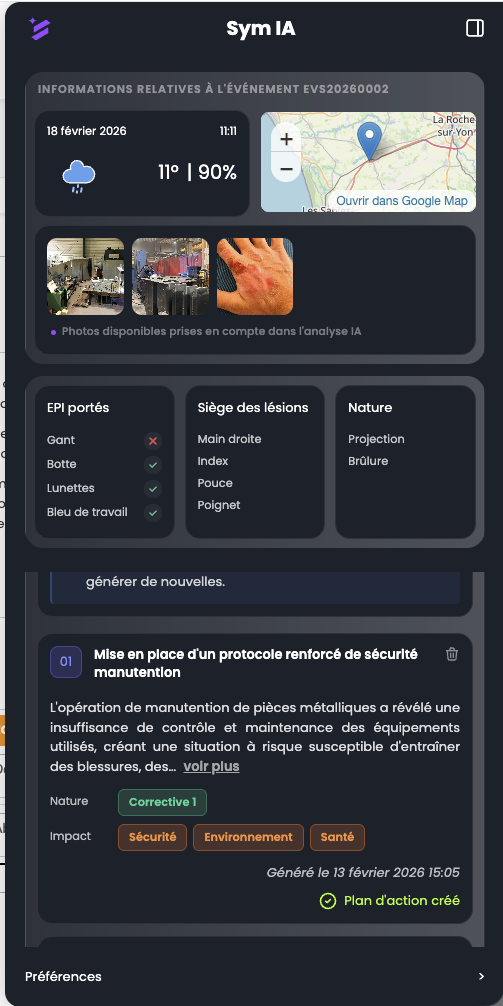
AI and digital tools (IoT, QHSE platforms) are transforming the way incidents are reported, analyzed and anticipated. These technologies make it possible to move towards proactive security.
Mental health, psychosocial risks and safety
Psychosocial risks (burn-out, stress, harassment) are now considered as part of “safety”. A genuine safety culture must incorporate mental health.
ESG/CSR integration in security
Safety is increasingly aligned with CSR issues: prevention and the protection of employees and stakeholders (suppliers, communities) are becoming a pillar of sustainability and responsibility.
Conclusion : safety culture as a driver of sustainable performance
Establishing a strong safety culture in 2026 means investing in a safer, more resilient and more efficient future. It's not just about compliance: it's a strategic lever for reducing risks, retaining talent, strengthening brand image, and improving overall performance.
Recommended first step : carry out a security maturity diagnosis.
Then, engage your teams in a participatory and continuous approach, and adopt digital tools to manage effectively.
At Symalean, with more than 15 years of QHSE experience, we support companies in the implementation of a True safety culture.
👉 Contact us for a free diagnosis or discover our QHSE solutions.


.png)