Accidents at work : an alarming human, social and economic reality
Key figures on work-related accidents in France
The statistics speak for themselves. Every year in France, We count nearly 550,000 declared work accidents, including several hundred deaths (CPAM, 2024). Behind these cold numbers lie much harsher human realities: irreversible injuries, permanent disabilities, psychological trauma, and sometimes the loss of a parent, spouse, or child.
The most exposed sectors — construction, industry, industry, logistics, maintenance — are also those where the human risk is the strongest. Despite decades of regulations, training, and procedures, The human factor remains the main cause of accidents at work.
Behind every accident, lives turned upside down
An accident at work is never a simple “incident.” It is an event that has a lasting impact on :
- the employee, whose career can change overnight,
- his family, facing a loss of income or a disability,
- his colleagues, who are often traumatized,
- and the company, which must manage the human, legal and organizational emergency.
Avoiding an accident at work is therefore not only about complying with a legal obligation. It means maintaining lives, family balances and fundamental human dignity.
Serious and fatal ATs : an invisible cost for businesses and the state
Beyond the human impact, workplace accidents represent a massive economic cost. A serious AT can cost between several tens and several hundreds of thousands of euros, taking into account :
- work stoppages,
- compensation paid by CPAM,
- AT/MP contributions are up,
- replacement and training costs,
- productivity losses,
- not to mention legal and insurance costs.
For a TPE or an SME, a serious accident can be a tipping point. In some cases, it can even lead to bankruptcy.
Besides, In a 2022 study carried out by CNAM, it is well specified that these accidents have a cost.
“In compensation for the days off work, Health Insurance pays daily allowances. They amount to 60% of the daily wage for the first 28 days, and 80% thereafter. On average, the direct cost of an accident at work is estimated at 4,800 euros.
However, this amount is far from the real cost. It is also necessary to take into account the expenses and expenses assumed this time by the company. The true figure would then be in a range of three to five times the value of the direct cost. That is between 15,000 and 24,000 euros per accident at work.”
Why is conventional prevention reaching its limits today ?
The overload of QHSE teams
QHSE managers face increasing complexity : multiplication of regulatory obligations, pressure on results, lack of human resources and time. Result: data exists, but it is rarely exploited to its full potential.
Accident records, almost-accidents, audits, field reports... All this information is valuable, but often scattered, heterogeneous and difficult to analyze manually.
The human factor, the main cause of accidents
The majority of workplace accidents are related to :
- routines set up,
- a loss of vigilance,
- unintentional risky behaviors,
- a poor perception of danger.
This is precisely where artificial intelligence can play a decisive role: Detect what humans no longer see.
Underexploited data in HSE approaches
SSE approaches are based on historical data. However, without appropriate tools, it is almost impossible to identify complex correlations, of weak trends Or recurring patterns harbingers of a serious accident.
Artificial intelligence and QHSE : a necessary revolution
Understanding AI-based risk management
La risk management through AI consists in automatically analyzing large volumes of data to :
- identify risk areas,
- anticipate dangerous situations,
- prioritize preventive actions.
Unlike a reactive approach, AI allows proactive prevention.
Can you really predict an accident at work ?
Predicting an accident at work does not mean reading the future. Rather, it is about Calculate probabilities, based on real and contextualized data. Thanks to intelligent models, it becomes possible to :
- detecting patterns similar to past accidents,
- identify combinations of risk factors,
- alert before a serious event occurs
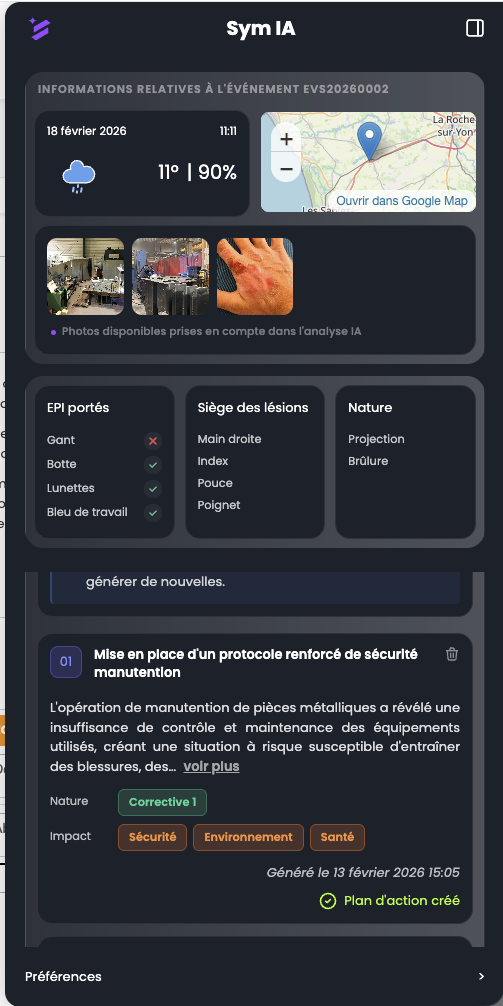
👉 This is precisely the approach developed by Symalean with our artificial intelligence SYM AI 🔗 https://www.symalean.com/sym-ai
Automatic AI and the prediction of dangerous situations
Automatic AI allows for continuous analysis, without fatigue or cognitive biases. It complements human expertise by providing :
- a global vision,
- a capacity for foresight,
- and an objective prioritization of risks.
Predicting to avoid : how does AI actually make it possible to avoid ATs ?
Identify weak signals before the accident
The majority of workplace accidents do not happen “by surprise.” They are preceded by Weak signals : minor incidents, almost-accidents, deviant behaviors, repeated non-conformities, increased fatigue, organizational faults... These are all elements that are often perceived in isolation, but rarely analyzed in their entirety.
It is precisely here that theQHSE artificial intelligence change the situation. By automatically crossing :
- histories of accidents at work,
- declarations of near accidents,
- HSE audits,
- field observations,
- organizational data (rhythms, positions, schedules, environments),
AI is capable of bring out correlations invisible to the human eye.
Instead of waiting for a serious accident to happen, the company can take action upstream, at a time when the risks are still manageable.
👉 Avoiding an accident at work starts with understanding what is going to happen.
Limiting serious accidents in business thanks to algorithms
Serious and fatal accidents are rarely due to a single factor. They result from a combination of causes : organizational, human, technical and environmental. AI makes it possible to model this complexity.
Using machine learning algorithms, solutions like Symalean's can :
- identify the most critical situations,
- prioritize risks according to their potential severity,
- recommend targeted actions with a high preventive impact.
The objective is not to multiply actions, but to Do the right things at the right time, where they will have the most effect. This is how one succeeds in limit serious accidents in business, in a sustainable and measurable way.
Avoiding an accident at work means protecting families
Behind every accident avoided, there is much more than one indicator that remains green. There are :
- a parent who goes home at night,
- a family that does not fall into precariousness,
- an employee who maintains his health and dignity,
- a team that does not experience the trauma of a tragedy.
At Symalean, prevention isn't just about compliance or performance. It is a human commitment.
Using AI to avoid workplace accidents means making the choice to avoid accidents and therefore tragedies, even if this word is sometimes considered to be a strong word. However, it is fair.
Symalean's commitment to useful and responsible AI
An AI at the service of humans, not the other way around
One of the major debates around artificial intelligence concerns its place in relation to humans. At Symalean, the position is clear: AI is not intended to replace humans, but to support them.
In the field of risk prevention, this approach is essential. AI does not decide for QHSE managers. She :
- analysis,
- alert,
- propose,
- prioritize.
The final decision is a human one. This philosophy is at the heart of the design of Symalean solutions and is part of a responsible vision of risk management through AI.
A clear and assertive ethical charter
Symalean formalizes its commitments through a ethical charter for artificial intelligence, publicly available :
🔗 https://www.symalean.com/ia-charte-ethique
This charter is based on several strong principles :
- respect for people and their integrity,
- protection of sensitive data,
- absence of irreversible automated decisions,
- fight against biases,
- exclusively preventive and positive purpose.
Far from the effects of announcement, this approach engages Symalean in using responsible, controlled and aligned with human values.
AI and the sovereign approach : a strategic challenge for French companies
Sensitive data, sovereignty approach and compliance
QHSE data is among the most sensitive in a company. They concern :
- the health of employees,
- working conditions,
- incidents and accidents,
- sometimes even complex legal situations.
Entrusting this data to solutions that are opaque or hosted outside the European Union poses real problems of sovereignty And of regulatory compliance.
Symalean chooses a sovereign approach compliant with the RGPD and French data protection requirements.
Why can't QHSE AI depend on opaque solutions ?
An artificial intelligence that influences preventive decisions cannot be a “black box”. Businesses need to know :
- where is their data hosted,
- how they are used,
- for what purposes they are used.
In a context of geopolitical tension and technological dependence, theAI must have a sovereignty approach. It is becoming a strategic issue, especially for industrial sectors and critical infrastructures.
Symalean, a European and responsible alternative
By developing a solution ofQHSE artificial intelligence ethical and responsible, Symalean offers a credible alternative to generalist platforms. An alternative aligned with European values, but especially with concrete challenges in the field.
Reduction in accidents = direct and indirect savings
The real cost of an accident at work for a company
The real cost of an accident at work is often underestimated. In addition to the immediate costs, you have to take into account :
- the increase in AT/MP contributions,
- extended shutdowns,
- the disorganization of the teams,
- the loss of know-how,
- the impact on the employer brand.
A serious accident can cost several hundreds of thousands of euros, or even more in the long term.
VSEs and SMEs: when a TA can lead to bankruptcy
For a small business or an SME, the margins are often limited. A serious workplace accident can:
- weakening the cash flow,
- lead to long and expensive litigation,
- jeopardize the very survival of the business.
Investing in solutions to avoid workplace accidents, like preventive AI, is therefore not an expense, but a strategic insurance.
CPAM, pension, insurance: the collective burden of accidents
Each work accident generates costs borne by the community :
- daily allowances paid by the CPAM,
- disability pensions,
- health expenses,
- expenses for pension systems.
Reducing workplace accidents also means reducing the financial burden on the State, for the benefit of society as a whole.
AI does not replace QHSE experts, it strengthens them
Deconstructing preconceived ideas about AI in prevention
One of the most frequent fears around artificial intelligence concerns Questioning human jobs, especially in areas with strong expertise such as QHSE. However, in the field of occupational risk prevention, this fear is based on a misunderstanding.
AI does not “know” how to prevent an accident on its own. She knows neither the cultural specificities of a company, nor the social realities of a work collective. On the other hand, it excels in what humans cannot do on a large scale : analyze massive volumes of data, detect complex patterns and calculate risk probabilities.
👉 To go further on this subject, Symalean has already taken a stand by writing an article on the subject : Is AI really replacing QHSE jobs? (spoiler alter : no).
AI is therefore not a threat to QHSE jobs. She is a a lever for valorizing their expertise.
AI as a decision support tool
In a modern HSE approach, the role of the QHSE manager is evolving. It is no longer just a question of producing documents or verifying compliance, but of pilot an effective and measurable prevention strategy.
Artificial intelligence then becomes a decision support tool :
- it highlights real priorities,
- it objectifies the choices,
- it makes it possible to justify actions to management.
By freeing up time on time-consuming analytical tasks, AI allows QHSE experts to refocus on what makes a difference: the field, the human and the support of change.
Towards more effective prevention
This complementarity between human intelligence and artificial intelligence paves the way for increased prevention. Prevention that is finer, more reactive and above all more effective in the long term.
This is precisely this vision that Symalean purports: a technology at the service of strengthened safety culture, not the other way around.
Towards sustainable, humane and economically virtuous prevention
Avoid accidents, preserve the future
Talking about prevention is not just talking about compliance or performance. It's doing a Choice of society. The choice to consider that every accident avoided is a collective victory.
Thanks to a ethical and responsible artificial intelligence, it becomes possible to act sooner, fairer and more effectively. Avoiding accidents today means maintaining the future of employees, businesses and territories.
A vision aligned with societal challenges
Reducing workplace accidents means:
- protect public health,
- strengthen social cohesion,
- limit the costs borne by the community,
- contribute to a more sustainable economy
In this sense, Symalean's approach goes beyond the corporate framework. It is part of a global social responsibility, where technology becomes a tool for human progress.
Preventing accidents, a societal choice
Artificial intelligence won't magically save lives. But used with responsibility, transparency and humanity, it becomes a powerful lever to avoid workplace accidents.
By choosing a Ethical and sovereign AI, Symalean shows that it is possible to combine technological innovation, economic performance and human commitment.
Preventing accidents means protecting employees, supporting families, strengthening businesses and relieving the community.
It is, basically, A choice of society.