What the 2024 Health Insurance Report tells us, and what we sometimes prefer not to hear
The 2024 Health Insurance Annual Report, Occupational Risks, published in November 2025, draws up a report that prevention professionals know, but which deserves to be read without a filter :
- 1,297 workplace deaths in France in 2024, i.e. more than 2 deaths every working day.
- 6 billion euros, the annual cost of occupational accidents and diseases (AT/MP).
- 300,000€ approximately, the average cost of a single serious accident for an SME.
These numbers are by no means inevitable. What is striking is that the vast majority of serious accidents are preceded by signals : almost accidents, repeated incidents in the same contexts or patterns that the data records faithfully. The problem is not the absence of information, it is our collective ability to read it on time.
The real challenge of prevention: not the data, but reading it
A QHSE manager who manages a site of 200 people can process, in one day, several dozen reports, regulatory requests and training courses to be planned. In this context, manually identifying that the same type of incident occurred five times in three months, always in the same sector and at the end of the shift, is a task that exceeds human processing capacities. It's not a lack of skill, but a lack of time and perspective.
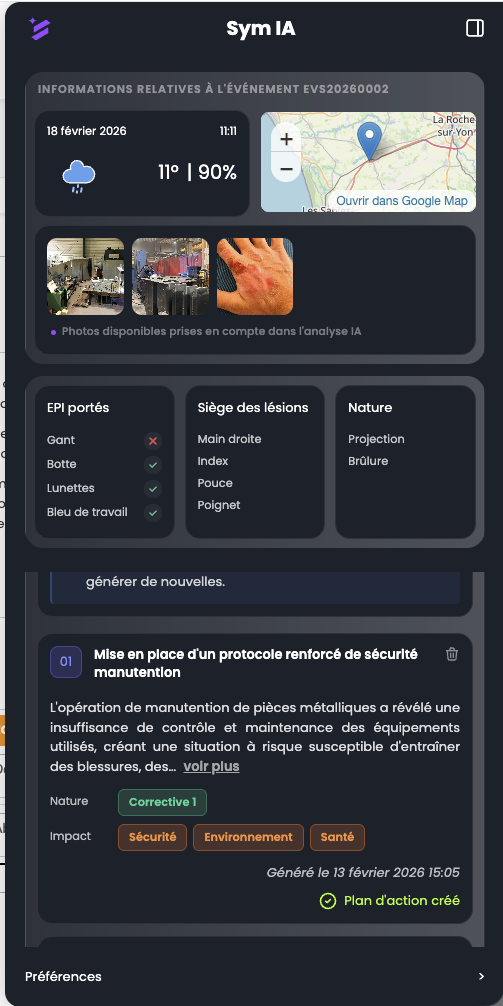
This is precisely where business AI brings something concrete. To understand the technology behind this analysis, it is essential to detail How does preventive AI via the recurrence detector and the coactivity radar work in practice.
Declarative prevention: necessary, but insufficient
Traditional prevention is based on a declarative model : an incident occurs, it is reported, and then analyzed. This model has structural limitations :
- It is reactive by nature : the measures are taken after the fact.
- It depends on the “I'm going to be fine” culture : reports are often under-represented.
- It produces siloed data : the information is scattered between the HRIS and the business software.
As a result, the same types of accidents come back. Not because of carelessness, but because the connections between the data are not visible to the naked eye.
What AI sees that humans can't see alone
AI is no substitute for the judgment of the prevention officer. In a few seconds, it processes volumes of data that no human can analyze manually to detect recurrences. Concretely, an AI agent is able to detect that the same type of incident occurs in a specific context (position, equipment, team configuration), even when the reports are scattered over 18 months.
This processing capacity makes it possible to prioritize alerts so that the QHSE manager knows where to focus his attention. However, this power is only effective if it is accepted by the teams. That's why Field AI only works with operational staff and real co-construction the settings of alerts. It's not magic, it's statistics applied to security.
A concrete example of an invisible pattern
Imagine three single-storey falls reported in six months. Individually, they seem isolated. But when crossed by AI, they reveal a pattern: same geographical area, same time slot, same phase of the production cycle. This pattern justifies targeted preventive action that, without data cross-referencing, would remain invisible.
From reactive to proactive prevention
This is the passage that AI makes possible : giving teams a higher level of reading. The vast majority of serious accidents are preceded by weak, identifiable signals. The challenge is to identify them early enough to take action.
To meet this challenge, Symalean developed its AI Agent. It is the first tool dedicated to QHSE prevention in French professional environments, designed to detect what humans alone cannot see in time, all in strict compliance with health data. For a complete immersion in this technology, you can download our White Paper, AI at the service of zero accidents: between predictive performance and ethical imperatives.