Disastrality 2024 : towards a decrease in accidents, but a worsening of diseases
The 2024 statistics confirm a trend that began in 2022 : the number of claims involving sick leave or permanent disability (IP) stands at 694,866 cases, representing a slight overall decrease of 0.3% compared to 2023.

Accidents at work (AT): a decreasing frequency
There is a decrease in 1.1% of workplace accidents, with a total of 549,614 claims set with stop.
- Frequency index : He settled in 26.4 per 1,000 employees.
- Mortality : 764 deaths were recorded in 2024 (+5 cases compared to 2023), with discomfort remaining the main cause (more than 50%).
- Major causes : Manual handling remains the first risk at the origin of accidents (50%), followed by falls from the ground (15%) and falls from a height (12%).
Beyond the number of claims, the impact on business continuity is massive. In 2024, workplace accidents caused more than 54 million days of downtime, which is the equivalent of 228,970 full-time (FTE) lost over the year.
While the overall frequency index is 26.4, the industry notes that 94% of declarations result in recognition, underlining a stabilization of management processes, but a persistence of residual risk.
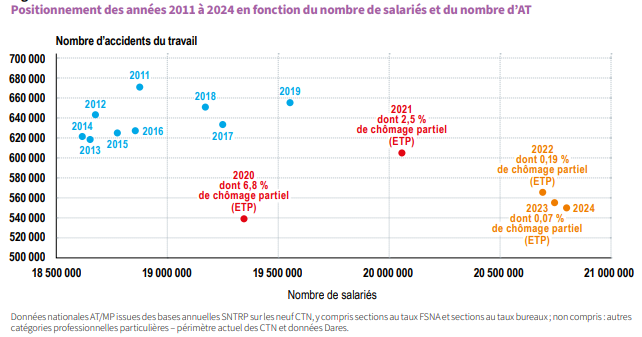
Below is an illustration from the Health Insurance report, indicating the performance (or stagnation) of security policies despite headcount growth (20.8 million employees). Indeed, the year 2024, like the years 2022 and 2023, “does not return to a pre-COVID-19 level of claims but continues the trend observed since the health crisis (illustration below). While, since 2021, the number of employees has increased, the TA has been decreasing, with in 2024 the number of employees being the highest of the decade, while the AT are the fewest.”.
Occupational Diseases (PM) : an increase of 6.7%
Unlike accidents, occupational diseases return to their pre-crisis level with 50,598 recognized cases (+6.7%).
- Musculoskeletal disorders (MSDs) : they represent nearly 90% of occupational diseases and increased by 6.6%.
- Asbestos : Asbestos-related pathologies increased by 8.5%.
- Psychosocial risks (RPS) : Psychiatric disorders are on the rise 9%.
Musculoskeletal Disorders (MSDs) confirm their status as the professional “disease of the century” by representing 89.4% of recognized occupational diseases. At the same time, the report highlights a resurgence of asbestos-related pathologies (+8.5% in one year) and a continuous increase in non-asbestos cancers, recalling that prevention must take place over the long term to counter the delayed effects of chemical exposure.
With 50,598 occupational diseases recognized in 2024, companies are facing increasing financial and human risks. The 6.6% increase in MSDs shows that conventional preventive measures are running out of steam. To counter this trend, the adoption of a risk exposure monitoring software is crucial. It makes it possible to digitize chemical or ergonomic risk exposure sheets, ensuring real-time monitoring and immediate reaction as soon as the first weak signals appear.
Focus on new issues: mental health and employment
The 2024 report highlights sectors and pathologies that require increased vigilance on the part of security managers.
The rise of psychological risk

The number of psychological occupational diseases a doubled between 2020 and 2024.
- Profiles concerned : nearly 50% of employees recognized in psychological MP are managers or higher intellectual professions.
- Gender : two thirds of the requests concern women.
- Accidents : ATs including a psychological pathology or a context of RPS increased by 14% in one year, reaching 29,000 cases.
Clarify these demographics. Psychological risk no longer only affects operational sectors. In 2024, two thirds of victims of recognized mental illnesses are women, and more than 50% are over 50 years old.
An important fact for HR strategies: almost half of employees recognized for a psychological condition occupy positions of managers or managers.
Workplace accidents that include an RPS dimension now represent 5% of total claims, with a meteoric rise of 14% in just 12 months.
As we have just seen, psychological disorders now represent more than 5% of all accidents at work. This figure highlights the urgency of moving from reactive management to preventive management. A QHSE module dedicated to mental health makes it possible to centralize stress and workload indicators., thus facilitating the identification of risk sectors, such as medical and social housing, which alone accounts for 18.5% of these accidents.
Inistrality in the interim
The temporary employment sector remains a major area of vigilance with a frequency index almost twice as much at the national level, despite a decrease in the total number of ATS (under 40,000 cases). Note that since January 1, 2024, the cost of claims has now been divided 50/50 between the temporary employment company and the user company.
Sectoral impact : which professions pay the heaviest price ?
The 2024 disaster rate is not distributed uniformly over the French economic territory. Some sectors concentrate a disproportionate share of risks and, by extension, financial costs.
%20en%202024.png)
The financial weight of Daily Allowances (IJ) by sector
The 2024 report reveals that the meteoric growth in daily allowances (€4.9 billion) is driven by a few pivotal sectors. According to the analysis of the amounts paid for work stoppages :
- Specialized Construction Works (NAF 43) occupy the first place, representing alone more than 10% of the total amount of IJ paid in 2024.
- Retail Trade (NAF 47) follows closely with 8.4% of the global financial burden.
- Land Transport (NAF 49) complete this trio with 7.0% IJ amounts.
- The Medico-Social Sector, combining human health and social action, weighs for a massive total of 15% of the national envelope of IJ.
Focus on specific risks: handling and Psychosocial risks
The nature of accidents varies greatly depending on the activity. If the manual handling remains the number one cause of accidents (50% of coded cases), it is particularly devastating in transport and logistics.
Conversely, the analysis of accidents related to psychosocial risks (RPS) shows an alarming concentration in services :
- Medico-social and social housing : 18.5% of accidents related to mental disorders.
- Land transport : 10.2% of cases.
- Retail : 7.6% of cases.
Why is a software approach vital for these sectors ?
Faced with these figures, “manual” security management is no longer enough. For a medico-social or commercial player, the increase in 14% of psychological accidents In one year represents a major risk of disorganization.
The Symalean approach for these sectors :
- Sectoral centralization : use specific indicators (frequency rate per work unit) to identify if your numbers exceed the average of your NAF code.
- Targeted prevention of MSDs : in the construction sector (10% of IJ), the digital monitoring of handling protocols makes it possible to reduce exposure and therefore the duration of shutdowns.
- RPS traceability : Faced with the explosion of psychological pathologies, a digital tool makes it possible to document the preventive measures taken, thus protecting the employer in the event of litigation.
Financial data: record expenses for work stoppages
For the first time in the history of the branch, the Daily Allowances (IJ) become the first item of expenditure, ahead of permanent disabilities.
- Amount of IJ : 4.9 billion euros paid, an increase of 10.8% in one year.
- Share of expenses : The IJs now represent 46% of expenses of the branch, compared to only 33% in 2014.
- Financial result : despite a surplus of 686 million euros, it is down sharply compared to 1.35 billion in 2023, due to the increase in expenses (+4.7%) and the decrease in contributions (-2.0%).
This is a real economic challenge for the company. Indeed, the financial structure of the AT/MP branch is undergoing a profound change. For the first time, the daily allowances (€4.9 billion) exceed expenses related to permanent disability pensions (€4.7 billion). This drift in costs (+10.8% for IJ) is explained by the extension of the duration of shutdowns. For businesses, this means increased pressure on the contribution rate, despite a technical decrease in the average net rate at 1.87% in 2024.
How does Symalean help you turn this DATA into action ?
The decrease in the national average net rate (established at 1.87% in 2024 (compared to 1.99% in 2023) should not mask the increase in costs related to absenteeism and occupational diseases.
The increase in daily allowances of +10.8% proves that the duration and frequency of shutdowns weigh heavily on business performance. To become a reference authority and protect your employees, real-time management via a digital QHSE solution such as Symalean is becoming essential to anticipate RPS and reduce MSDs.