Why are current QHSE processes dysfunctional ?
The hidden cost of fragmented and manual feedback
Most organizations still rely on paper forms or disparate applications to report incidents. As specified in the QHSE 2024 Barometer conducted by DEFI, “only 10.5% of companies have digitized their prevention plan, and barely 7.9% use digital tools to conduct their audits Of land“. This approach generates several structural problems that slow down prevention.
Feedback delays stifle reactivity
Let's take a simple example: an incident occurs on the ground at 10:30am. The agent finishes his tasks, finds a form, completes it manually, submits it to his manager. Several days pass before the information reaches the QHSE manager. In the meantime, other employees have been exposed to the same risk without any immediate corrective measures.
Manual entry creates critical data loss
Incomplete forms, transcription errors, and divergent interpretations make analysis difficult. Some QHSE managers spend up to 40% of their time cleaning and standardizing data received from the field, rather than analyzing them to derive preventive insights. This is a waste of time that could have been spent on real prevention.
User adoption is stagnating
When a system is perceived as cumbersome or restrictive, employees find workarounds. They report less, forget crucial details, or use unofficial channels. Result: the data collected no longer reflect the reality on the ground. Incident statistics are becoming unreliable and preventive decisions are based on a fragile basis.
Regulatory constraints amplify the pressure
ISO 45001, the PSE directive 2006/42/EC and traceability obligations require rigorous and time-stamped documentation of incidents. The QHSE manager must be able to demonstrate, at any time, that the feedback was carried out correctly, that the analyses followed best practices, and that the corrective actions were launched.
However, in a fragmented manual system, this traceability remains time-consuming and incomplete. Emails are lost, change histories are not kept, responsibilities become unclear. In the event of an audit or disaster, this fragility can become a problem.
The impact on safety culture and performance
An ineffective reporting process ends up affecting the safety culture itself. Employees are asking themselves: “What's the point in reporting if it takes three days and requires a lot of paperwork?” Progressively, prevention is becoming an imposed formality rather than a shared conviction.
On the other hand, when reporting is simple and preventive actions follow quickly, safety culture takes root. Employees understand that their signal counts and that it produces concrete results.
The QHSE revolution in field feedback
One click, one photo, the rest is automated
Intelligent automation is not about digitizing old forms. It consists of Start from scratch with a simple question: “What is the smallest thing a field agent should do?”
The answer: take a photo.
That is all. A photo from his professional phone. It is a gesture that he already knows, that he is already doing. No special training required. There is no form to fill out. No classification to choose from.
From this simple image, a set of technologies converge to transform this photo into action intelligence:
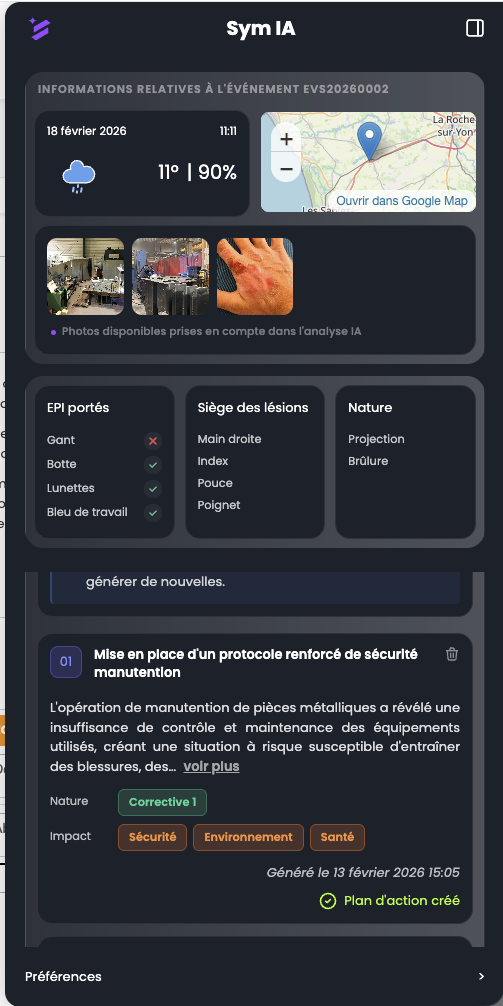
- Image recognition automatically analyzes the contents: missing equipment, damaged surface, chaotic situation, dangerous posture. It identifies elements that are visually relevant to security.
- The automatic description of the image generates a structured text report, in natural language, that describes what she sees. This description becomes the basis for reporting.
- Determining the typology operates automatically based on this description. Is it a near miss? An observed discrepancy? Exposure to a hazard? An equipment defect? SyMai, the QHSE AI, classifies the incident according to the categories you have defined.
- Data anonymization is carried out before the feedback is processed in order to guarantee the protection of sensitive information. Anyone visible is blurred, any personal identifier is removed or pixelated. You capture the facts, not the individuals. It is prevention that respects personal data.
- Contextual enrichment automatically adds: the precise geolocation, the date/time, the site identifier, the history of similar incidents at this location.
A raw photo becomes a complete, trackable, traceable, anonymized, and enriched report. Without manual intervention by the field agent.
The architecture of transformation : Dyo and SymAi in synergy
What is the role of SyMmAi ?
SyMai offers visual assistance that transforms images into intelligence in order to recognize risky situations. You create your lift from the mobile application, then you integrate your terrain photo into it. From there, SyMai automatically triggers the AI analysis.
Concretely, how does that happen in the QHSE software ?
Step 1 : Recognition and analysis
SymaI analyzes each pixel of the image to identify objects, people, equipment, surfaces, situations. She understands the context (is it a mechanical workshop ? A construction site ? A warehouse ?).
Step 2 : Full and ethical anonymization
SymaI detects any human presence and anonymizes it: blurring faces, masking badges or identifiers, deleting all personal data. The photo captured for prevention respects everyone's privacy.
This responsible and ethical approach is fundamental. You can also read our ethical charter, the one who guides each of our developments/ It signals to employees : “We want to learn from situations, not watch you.”
Step 3 : Smart Description
From this analysis, SymaI generates a structured textual description, written in natural language, that captures the elements relevant to security.
For example : “Lifting equipment with no visible signs. Work area with accumulation of debris. Lack of protective plinth.”
This description highlights the anomalies and risks detected.
Step 4 : Automatic classification
SymaI automatically determines the category of incident :
- Near-accident (situation that could have been serious)
- Variance observed (non-compliance noted)
- Exposure to a hazard (employee in contact with a risk)
- Equipment failure
- Organizational failure
This classification feeds directly into the centralized action plan and makes it possible to generate preventive actions.
Why does this approach work ?
First reason : The simplicity of adoption.
A photo is a natural gesture. No friction Field agents adopt immediately.
Second reason : The absence of data loss.
Everything is captured automatically. Nothing is lost in the translation between the field and the office.
Reason three : Intelligence increases quality.
SymAi does not make input errors, does not fatigue, does not bias. It classifies consistently.
Fourth reason : The human remains in control.
AI proposes and assists. But every critical decision remains a human responsibility. This is how the responsibility is clearly committed.
Reason 5 : Traceability is guaranteed.
Each step is recorded, time stamped, and documented. No ambiguity in auditing.
Ethics remains at the heart of our innovation
SymAi protects your data
Image recognition technologies offer extraordinary capabilities. But with these abilities comes ethical responsibility: not use technology to monitor or control individuals.
At Symalean, this belief is fundamental. Image recognition in the service of prevention must be accompanied by scrupulous protection of personal data.
How anonymization works ?
When SymaI analyzes an incident photo, it simultaneously detects any human presence. Immediately, these elements are anonymized by several mechanisms :
Face detection and blur.
Any visible face is detected and blurred in real time. Not post-processed after the fact, but directly at the time of the analysis.
Deleting identifiers.
Access badges, names, personal logos or serial numbers: all removed, blurred or pixelated.
Masking contexts that are too revealing.
Some visual details could identify a person or their precise location. They are masked.
Controlled consent.
Only the anonymized and processed version is archived for traceability.
Why is it necessary and essential for safety culture ?
When employees know that incident photos are analyzed ethically, without personal supervision, they are more likely to report. They understand that the aim is to improve prevention, not to control it.
This trust is fundamental for a culture of authentic safety and in trust with your teams. Reporting then becomes an act of collective commitment.
Best practices for maximizing impact
Best practice 1 : involve field teams from the design stage
Agents in the field have the intelligence of operational realities. Consult them on :
- What is slowing them down today
- What they forget to report and why
- How to really simplify the ascent
Their involvement at the beginning facilitates mass adoption at the time of deployment.
Best practice 2 : turning data into visible actions
Automated feedback only creates value if it leads to concrete and visible actions.
Ensure that every reported incident leads to tangible corrective action. And that this action is communicated to the field: “Thanks to your report on 15 May, we had to replace the faulty equipment. Three potential incidents have been avoided.”
This feedback loop reinforces culture and reporting.
Best practice 3 : establish clear and shared indicators
Before deployment, define what you are going to measure :
- Ascension delay
- Data completeness
- Rate of closure of corrective actions
- Incident frequency rate trend
- User satisfaction
These indicators must be visible to all and commented regularly at QHSE management meetings.
Best practice 4 : value and celebrate reports
Paradoxically, when reports increase, it's generally a good sign. That means the culture is improving and the system is working.
Celebrate teams that report. Share examples where a report prevented a serious accident. Show that prevention works.
Best practice 5 : train QHSE managers in AI as an assistant
AI is not autonomous. It assists humans. Train your HSE managers to understand :
- How SymAi classifies incidents
- When to trust the classification and when to adjust it
- How to interpret action recommendations
- How to use aggregate data for prevention
A HSE manager trained in AI becomes infinitely more effective.