What is double materiality?
Materiality: an essential concept for ESG reporting
Let's start with the basics: materiality. This principle comes from English and is mostly used in financial jargon.
“Materiality” is identifying all the elements that are likely to have an impact on a company's activities and stakeholders and determining their importance. These identified elements are considered “material” as long as they are likely to influence decision-making processes.
Now applied to the world of CSR, this concept of materiality makes it possible to identify in a tangible way the list of the most relevant issues and indicators and to classify them in order of priority.
How does double materiality redefine the reading of ESG issues?
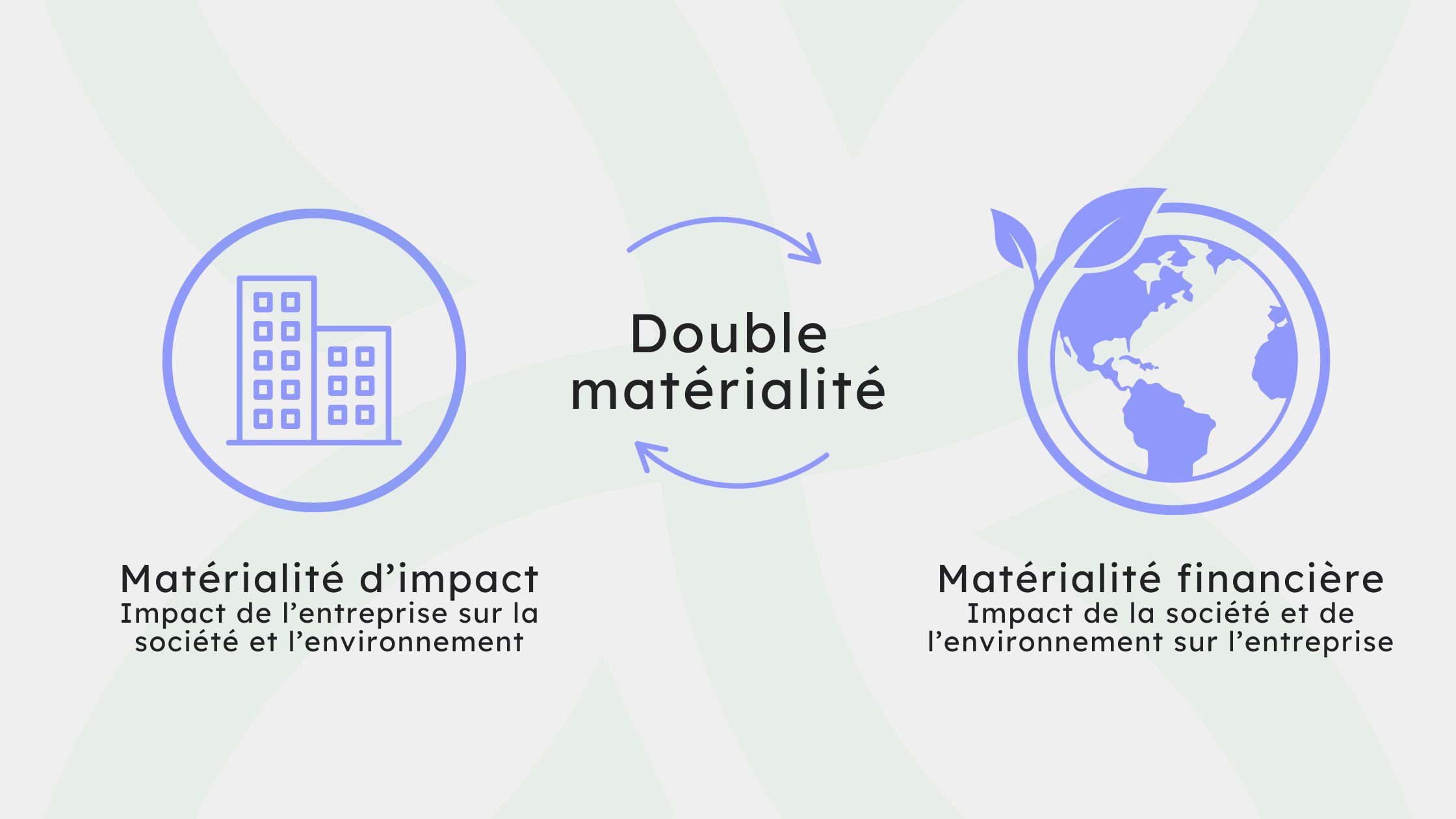
La double materiality is a structuring concept of ESG reporting, which invites companies to analyze environmental, social and governance issues from two distinct but complementary perspectives.
- Financial materiality : this is to examine how the external universe (social environment) affects the financial performance of my company. Does this financial materiality represent a risk of loss or present an opportunity for my business to gain?
- Impact materiality : here, we want to assess how the company, through its activities, impacts society and its environment, through its greenhouse gas emissions, its social practices or even its supply choices.
This approach embodies a profound change : it is no longer limited to a financial risk management logic, but requires organizations to consider their global responsibility. By integrating dual materiality into their strategy and reporting, companies can better prioritize their actions, strengthen their credibility with stakeholders, and build a sustainable performance, both economic, social and environmental.
👉 To better understand the foundations of ESG and the role of its three pillars (Environment, Social, Governance), consult our dedicated article: What is ESG? Deciphering the Environmental, Social, Governance pillars.
Why did double materiality analysis become necessary?
THEdouble materiality analysis is now becoming a central tool in the management of ESG strategies. Previously focused on financial materiality, companies must now broaden their prism to also include environmental and social impacts of their activities. This change in perspective is driven by strong regulatory developments (CSRD, Green Taxonomy, CS3D,...) and by growing expectations on the part of investors, customers, employees and regulators.
La double materiality meets a fundamental need: to help businesses to prioritize their ESG issues. By combining an evaluation of economic risks/opportunities And environmental and social impacts it makes it possible to identify priority topics to be integrated into internal policies, CSR roadmaps or even the ESG reporting.
Beyond compliance, this analysis becomes a strategic lever. It offers a global vision of the strengths and weaknesses of the company in the face of ongoing transitions (climate, regulatory, social). It also promotes a strategic and unbiased decision-making, based on tangible data, and governance aligned with long-term sustainability requirements.
Dual materiality is redefining business strategy
The introduction of the double materiality is profoundly transforming the way businesses design their ESG reporting. It is no longer just an exercise in transparency, but a real strategic management tool.
This approach requires reading at two levels: what impacts the business (ESG risks/opportunities for its profitability and value) and what The company impacts (on society, the environment, human rights). This double reading implies a better integration of ESG issues into corporate strategy, by combining financial performance and social responsibility.
In other words, the dual ESG materiality does not just document data but questions the economic model itself. What are the long-term effects of our decisions? Are we aligned with global resources and respect for human rights? What extra-financial indicators should drive our actions in the same way as financial KPIs?
Businesses must adopt a vision and a logic of transformation that is at the same time economically viable, socially just and environmentally sustainable.
How to carry out a double materiality analysis? In 5 key steps
Make a double materiality analysis cannot be improvised. It is a structuring exercise to prioritize relevant ESG issues, align strategy and reporting, and meet regulatory requirements. To facilitate this process, software solutions such as Regensy make it possible to secure, streamline and professionalize each stage of the process.
Step 1: map the company and its activities
The first step is to list the various activities of your business and map it as a whole:
- Structuring the different levels of entities,
- Secure the access of internal or external contributors,
- Analyzing the dependencies and impacts of the value chain,
- Identify the IROs (Impacts, Risks and Opportunities) key for your business.
This first step is essential to lay the foundations for your ESG analysis. These elements contribute to a reliable, contextualized analysis that is aligned with current European standards and regulations.
Step 2: involve stakeholders in a structured approach
To carry out the analysis of double materiality, it is essential to actively interview your stakeholders: employees, partners, investors, customers, suppliers... This approach facilitates the identification of material challenges by combining their impact on society and their potential influence on company performance.
The Regensy tool allows this double materiality analysis to be carried out in a fluid manner. :
- Creation of questionnaires to interview your internal and external stakeholders,
- Automated reminder management and data collection,
- Assessment of the relevance of their answers,
- Visualization and analysis of results in real time.
In a few clicks, Regensy allows you to identify your material challenges and consolidate a clear vision of your Strategic IROs.
Step 3: assess, structure and meet regulatory requirements
Once the issues have been prioritized, it is crucial to link them to the planned disclosure requirements, in particular data points (DP). This involves collecting the right data, producing the expected narratives and monitoring the progress of work collaboratively.
Specialized tools offer functionalities to organize this data, track its completion as a team, and structure documentation in the right formats (PDF).
Step 4: pilot action plans
With Regensy, you can go even further and trigger concrete action plans:
- Prioritize actions on 5 levels of criticality,
- Enrich your plans withintegrated artificial intelligence,
- Define new ESG strategies,
- Manage the implementation in a collaborative and measurable way.
Once the dual materiality analysis stage has been completed, concrete action plans must be triggered, aligned with the company's overall strategy and its ESG commitments.
The objective is to move from theory to practice, by defining clear goals, of monitoring indicators, of responsible persons identified And realistic deadlines. Each action must respond to a priority issue and be integrated into a logic of gradual but measurable transformation.
A solution like Regensy makes it possible to orchestrate this phase in a structured and collaborative way :
- Prioritization : the issues can be ranked on five criticality levels, depending on their impact and urgency.
- Structuring : each action plan is linked to the IROs identified, with a clear vision of the objectives, drivers, deadlines and resources mobilized.
- Artificial intelligence : Regensy can suggest actions or enrich existing strategies based on industry best practices.
- Collaboration : each member of the team can monitor progress, contribute to the implementation and report field results in real time.
- Strategic alignment : plans can be combined with existing company policies (CSR, climate, responsible purchasing, HR, etc.) to ensure overall coherence.
This control not only allows Take action, but also to demonstrate the company's commitment to stakeholders and auditors.
Step 5: Audit, Publish, and Share Your Sustainability Report
Once the double materiality analysis has been carried out and the actions launched, there is one key step left: document and disseminate results in a transparent manner and in accordance with regulatory requirements. The sustainability report then becomes a reflection of the company's commitments, but also a tool for dialogue with its stakeholders.
Before publication, this report must be checked, structured and formatted. This involves several elements:
- Organize everyone's contributions (finance, CSR, HR, legal...),
- Trace internal validations,
- Preparing the content to be transmitted to the listeners,
- Generate the right formats (PDF for reading).
To simplify this sometimes complex process, some solutions such as Regensy offer adapted functionalities:
- Secure access for auditors so that they can directly consult the data to be verified,
- Exportable formats compliant with new standards (PDF for distribution, XBRL for digital reporting),
- A centralized sharing system to send the final report securely to the relevant stakeholders.
The aim is to make this phase fluid, reliable and collaborative, while complying with the transparency requirements imposed by the CSRD. A good tool thus makes it possible to transform a regulatory constraint into Lever of trust and the valorization of the company's ESG commitment.
ESG and double materiality : what Symalean brings you
Chez Symalean, we help businesses structure their double materiality analysis via an approach technological, ethical and personalized :
- Smart digital tools to map issues, collect data and automatically generate visual matrices.
- Sovereign and ethical AI to detect weak signals and anticipate risks.
- Customized support with our QHSE/ESG experts.
Chez Symalean, we are convinced that ESG transformation cannot be based solely on regulatory compliance. It requires a strategic approach that is equipped and aligned with the specificities of each organization. That's why we support businesses at every stage of their double materiality analysis, with a unique combination of sovereign technology, of proven methodology And ofhuman expertise.
Digital tools designed for efficiency
- Mapping your ESG challenges in connection with your value chains,
- Collect, centralize and qualify data,
- Automatically generate visual matrices clear and usable,
- Monitor the progress of actions and facilitate the production of your reports.
Sovereign and ethical artificial intelligence
Regensy integrates a AI designed and hosted in Europe, which helps you:
- Identify the Weak signals linked to your impacts or to your sector,
- Anticipate the emerging ESG risks,
- Enrich your action plans with smart suggestions,
- Gain greater responsiveness in decision making.
Human and personalized support
Beyond the tool, we provide you with:
- Of QHSE and ESG experts to guide your approach,
- A press on the regulatory reading (CSRD, ESRS, CS3D...),
- Methods adapted to your sector, size and maturity level,
- Long-term follow-up to integrate your reporting into a logic of continuous improvement.
Integrating dual materiality: a strategic opportunity to act sustainably
Faced with the evolution of regulatory requirements and societal expectations, integrate the double materiality It is no longer a matter of choice but a matter of strategic responsibility. Far from being a constraint, this approach allows businesses to better understand the interactions between their activities, society and the environment — and to guide their decisions accordingly.
By combining financial performance and societal impact, dual materiality becomes a powerful lever for rethinking priorities, strengthening transparency and building a truly sustainable strategy. It is also a way to enhance the company's commitment to its stakeholders and to secure its long-term resilience.
Chez Symalean, we work with and for businesses. Our aim? Transform this obligation into competitive advantage : thanks to our Regensy solution and the expertise of our teams, each organization can structure its analysis, manage its actions and publish ESG reporting that is both compliant, credible and useful.
👉 Do you want to take action? Let's talk about it.