Why be interested in types of artificial intelligence when working in QHSE or ESG ?
AI is no longer a subject reserved for research laboratories. It is now used in the software you use on a daily basis: from document management to the analysis of action plans.
However, behind the word “AI” are hidden several technological realities. And understand The different types of artificial intelligence allows you to assess their potential — and their limits — in your QHSE and ESG jobs.
We explain the three main types of AI, their specificities, and above all How they are applied concretely in Symalean tools.
Weak AI: specialized intelligence at the service of repetitive tasks
Definition and characteristics of weak AI
Weak AI, also called narrow AI, is designed to perform a specific task without being aware of the global context. In fact, she doesn't understand what she's doing in the human sense of the word, but she's extremely efficient in its targeted field. It is The most used type of AI today, especially in business tools.
It is generally based on supervised learning algorithms, fed by databases specific to a given problem.
Examples of daily applications
- Automatic detection of faces or objects (for example, to unlock your smartphone) ;
- Classification of document ;
- Suggestion of personalized content ;
- Voice or text recognition.
Using weak AI for QHSE
At Symalean, this type of AI is already integrated into several modules and allows :
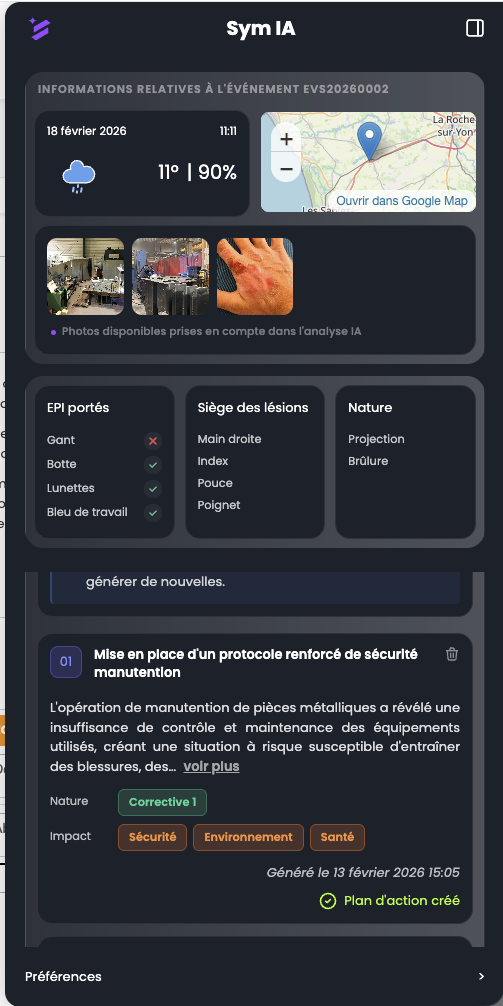
- La automatic report generation based on field data.
- La text and face detection for anonymization photos taken in the field.
- La Suggested corrective actions depending on the type of event declared and its recurrence.
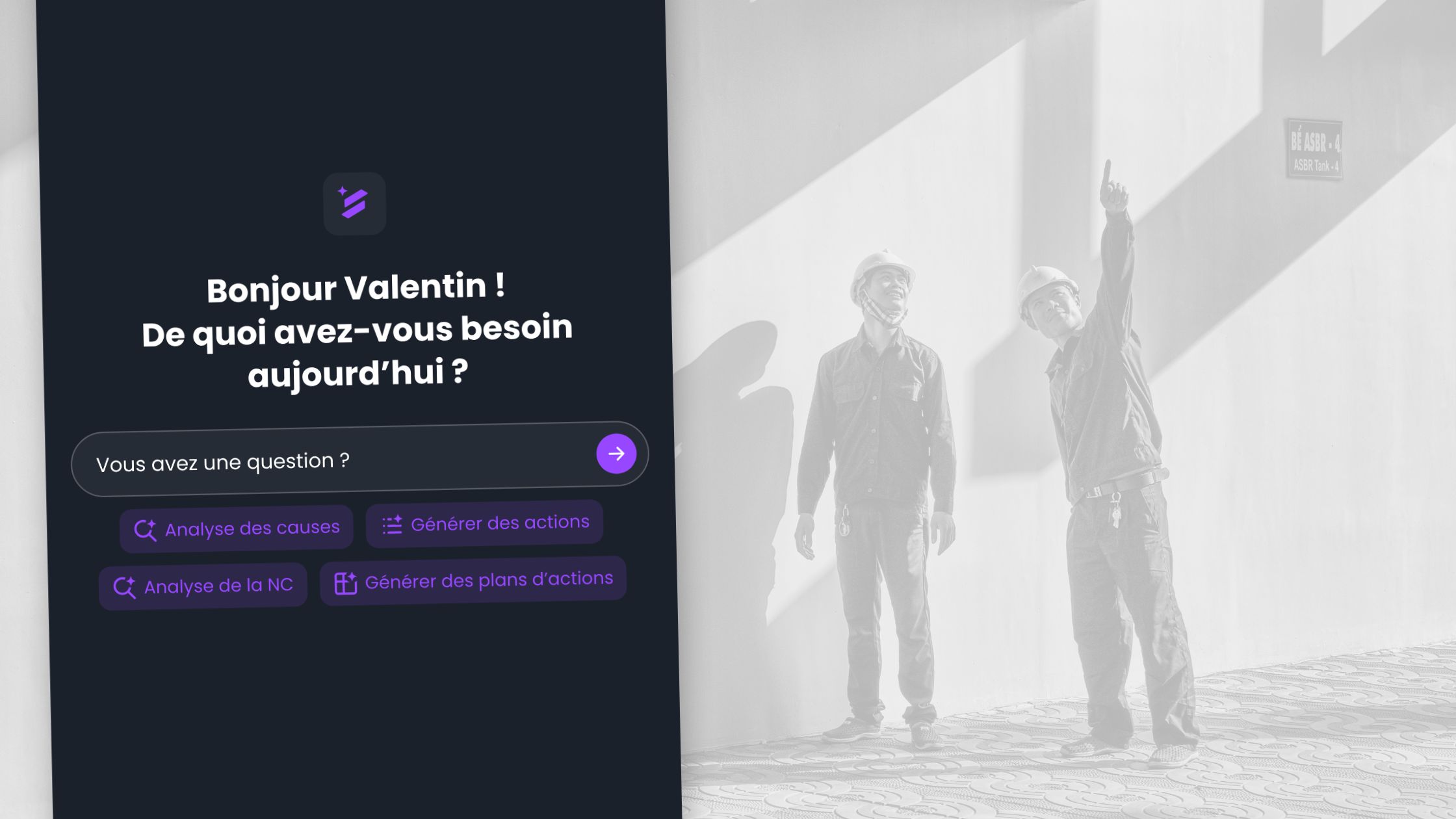
- Assistance in writing QHSE reports : the AI generates a structured summary based on the data entered by the user.
This weak AI Saves time, reduces human errors and frees your teams from repetitive tasks.
We can go further and ask ourselves whether the integration of mechanisms Agentics in our tools could bring that closer to strong AI. The answer is no: even by mobilizing several specialized agents, we are not yet talking about strong artificial intelligence.
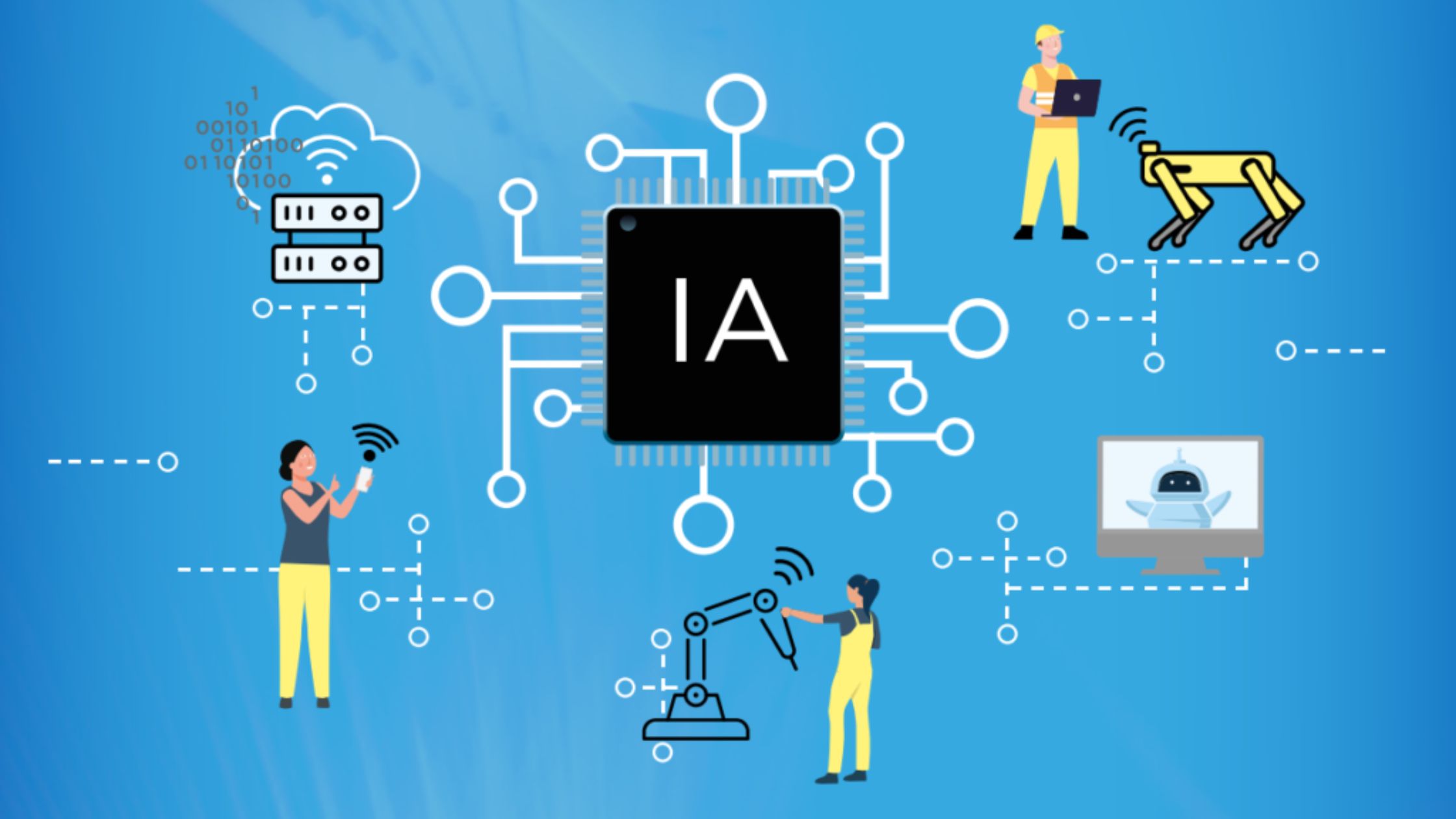
THEAgentic AI consists in setting up a set ofautonomous agents able to coordinate with each other to accomplish complex tasks (for example: visual analysis, regulatory monitoring, treatment of non-conformities).
For example, for QHSE, we can imagine a collaboration in four stages:
- A “visual analysis” agent detects, on a photo uploaded via our mobile application, an oil leak at the foot of a machine.
- It alerts the orchestrator, who mandates the “SSE event” agent to create a draft incident sheet (photo, time, location) and asks the “Regulatory Watch” agent to attach the safety instructions from the oil SDS.
- Once the event is created, the orchestrator requests a “nonconformity analysis agent”. Its mission: to delve into history. He finds that two similar leaks have occurred on this machine park in the last 6 months, both linked to the failure of a specific seal.
- Finally, the agent reports this crucial information to the orchestrator, who calls the agent “SSE event” so that he can update the form with an adapted analysis suggestion.
This approach Multi actors — where a conductor entrusts sub-tasks to expert agents — is one of the most effective methods for creating QHSE and ESG systems more powerful, more autonomous and better adapted to the realities of the field.
Strong AI : the promise of general intelligence... but still theoretical
Definition and characteristics of strong AI
Strong AI (or AGI — Artificial General Intelligence) refers to an AI capable of Reason like a human, that is, to learn, understand and act in any field without being programmed for a specific task.
Why is this type of AI not yet used in business ?
To this day, this AI remains A theoretical concept. No existing AI has human cognitive abilities: emotion, intuition, awareness of the global context. So we don't talk There is no such type of AI in QHSE tools current. But it is a long-term perspective to follow. It remains an ambitious goal of AI research, but no current system has cognitive abilities comparable to those of humans.
Future potential in QHSE and ESG
In the long term, one could imagine that a strong AI could:
- Bring a global and cross-cutting understanding of QHSE, social, environmental and economic issues.
- Formulate standalone strategies from multiple sources of information.
- Interacting naturally with the teams, like an expert assistant.
But in 2025, these uses are still prospective.
Symbolic AI: for transparent and traceable decisions
Definition and characteristics
Symbolic AI does not rely on data learning, but on explicit logical rules. It is based on the principle: “if such condition is met, then such action is recommended”.
It's an AI Understandable and trackable, ideal in highly standardized environments such as QHSE or ESG.
Indeed, in a regulatory or normative context, it is Exactly what is needed : power Trace the logic of a decision.
How symbolic AI is integrated at Symalean
In our solution Regensy, dedicated to ESG, symbolic AI is used to :
- Automatically structure reports according to regulatory requirements.
- Check the ESG data compliance according to standards (GRI, ESRS...).
- Recommend relevant indicators in terms of double materiality.
This type of AI is also used in some Dyo modules to verify compliance rules in QHSE audits. You can consult our knowledge base to find out the scope of our artificial intelligence within Dyo.
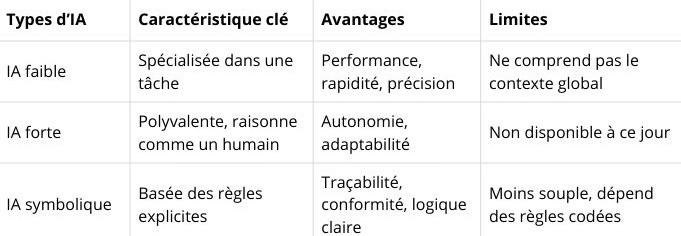
Comparison of the three types of AI
Here is a summary table of the types of AI.
Why combine several types of AI in the same solution ?
QHSE and ESG issues are varied : some involve automatic processing, others require reasoning based on legal or protocol rules. That is why we are choosing combining weak AI and symbolic AI in our tools.
This makes it possible to provide our customers with:
- One Operational AI, which automates and accelerates processes.
- One Trusted AI, designed to secure decision-making.
- One Custom AI, based on customer data.
Which AI for which QHSE/ESG situation?
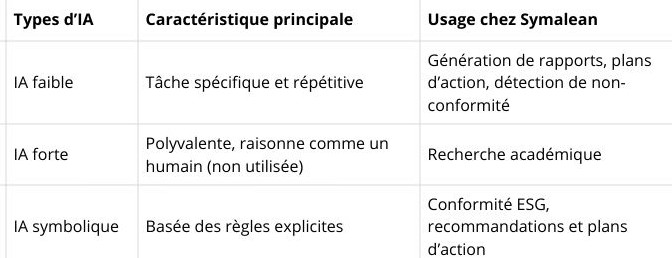
The types of AI at Symalean
We have written an ethical charter that details the foundations of our artificial intelligence, as well as the application of our artificial intelligence applied to our solutions.
Concrete examples
- One HSE non-compliance is declared → the AI analyzes the causes, assesses the severity and makes a clear summary. It then generates immediate actions and an adapted prevention plan to avoid any recurrence.
- One SSE event is declared → the AI synthesizes the information, identifies the immediate causes and analyzes the contributing factors. It then proposes targeted action plans to prevent any recurrence.
QHSE and ESG software: choosing the right AI for a concrete impact
At Symalean, we don't believe in a “gimmick” AI. We are building a embedded, useful and understandable intelligence, which supports QHSE and ESG professionals on a daily basis.
By combining the different types of artificial intelligence, we enable our customers to work more efficiently, to secure their analyses and to gain confidence in their management.
Each type of artificial intelligence has its advantages. The whole thing is choose the one that corresponds to your business challenges.
At Symalean, we intelligently combine weak and symbolic AIs to create really useful QHSE and ESG solutions, with no fashion effect. Our tools do not replace humans: they support them, save them time, and secure their decisions. Besides, you can discover our blog article which goes further on this subject: Is AI really replacing QHSE jobs? (spoiler alert: no).
Do you want to know more about our AI approach?
Make an appointment for a personalized demonstration of our software solutions.