What is artificial intelligence?
Artificial intelligence refers to the ability of a machine to reproduce certain human cognitive functions: learn, reason, analyze, anticipate.
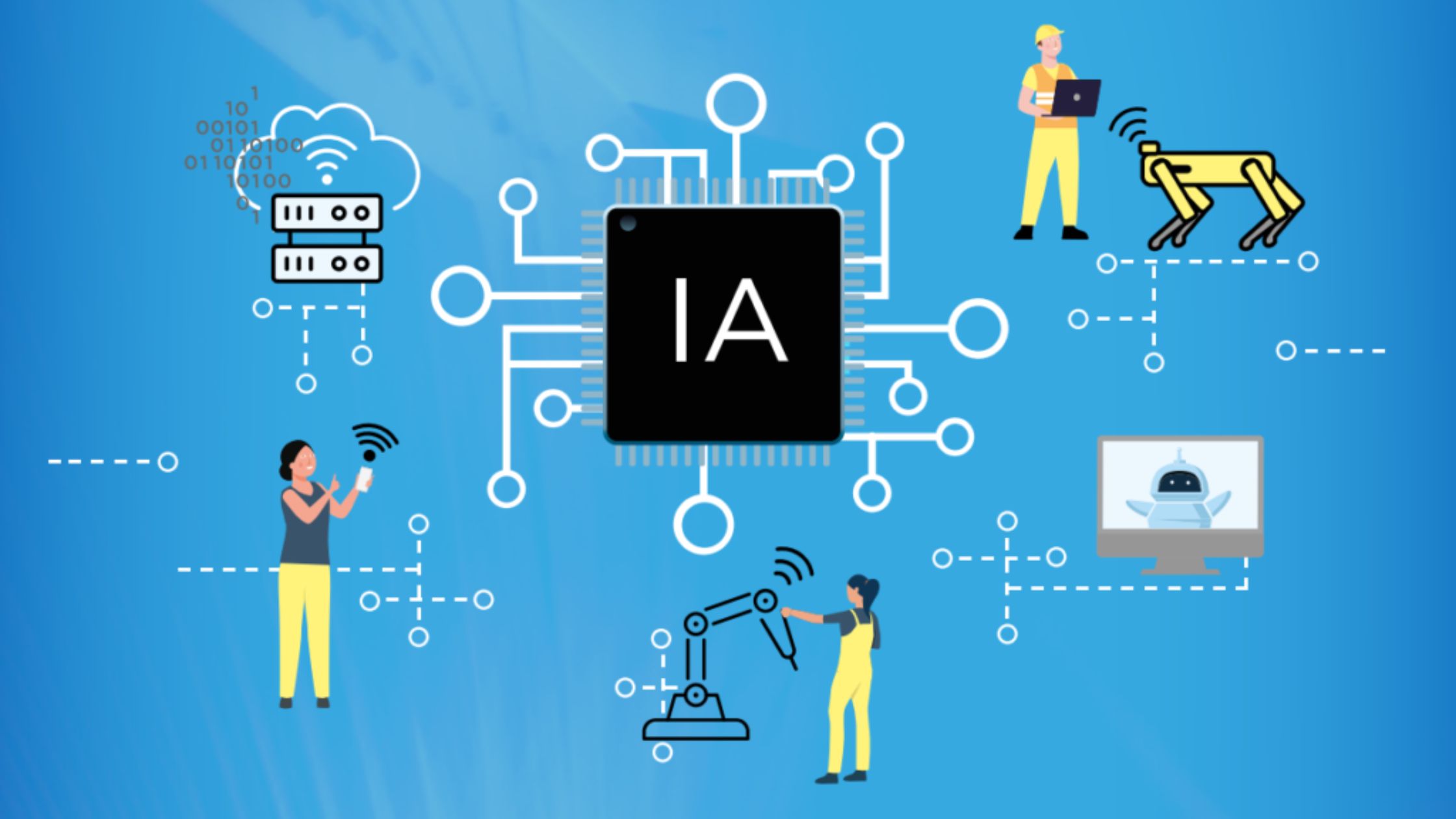
It is based on three fundamental pillars :
Infrastructure
It is the invisible but essential brick. Whether on the cloud or dedicated servers, the infrastructure provides the computing power and storage space needed to process millions of data in real time. Without this robust and secure foundation, there is no powerful AI.
The data — the DATA
Without data, there is no artificial intelligence. La Data is the fuel for AI : the richer and more well-structured it is, the faster and better the algorithm learns.
For businesses, this means collect quality data, to structure them, but above all to transform them into a living and actionable knowledge base. It is this capital of knowledge that will give AI its business intelligence.
We have written an article on the subject, discover it to go further Why is structuring your data a prerequisite for any QHSE AI?
Machine learning
Machine learning is the heart of AI. It allows an algorithm to improve based on data, without being explicitly programmed for each task.
There are mainly two main approaches:
“Predictive” AI
It is the most well known approach. By analyzing a large volume of historical data, AI learns to identify recurring patterns to make predictions. It is this technology that makes it possible to detect a fraudulent transaction on a credit card or to predict the demand for a product in a store.
“Generative” AI
It is the most recent revolution. This new generation of AI is not just about predicting. She is able to understand, synthesize and create entirely new content (texts, images, etc.).
Predictive AI vs. generative AI: what's the difference?
Let's imagine that artificial intelligence has access to a huge library.
Predictive AI could tell you: “Based on the 10,000 books I analyzed, this new copy has a 95% chance of being a detective novel.”
In fact, generative AI could answer the following request: “Write me a summary of Chapter 5 of this book” or even “Write a new paragraph in the style of this author.”
It is this ability to understand the context and generate relevant responses that is now transforming all sectors, and more particularly QHSE.
Artificial intelligence in QHSE: what added value?
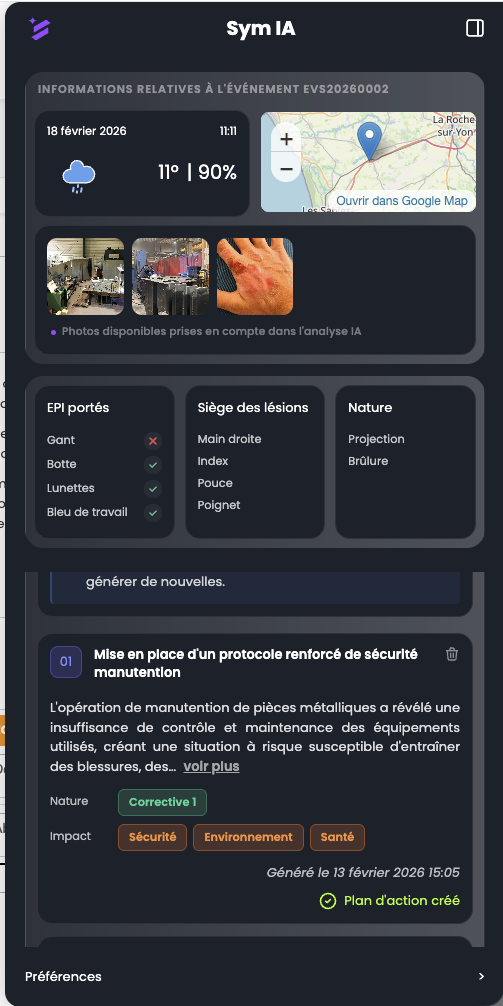
Applied to the field of QHSE, artificial intelligence is becoming a real performance driver. In fact, it allows you to:
- Automate repetitive tasks : generating reports, assigning action plans, processing forms...
- Detect anomalies more quickly : non-conformities, excesses, latent incidents.
- Predicting risky situations before they happen.
THEQHSE support then becomes more fluid, more reliable and better documented.
The pillars of AI applied to QHSE management
The QHSE cloud
It centralizes data from the field, audits or reports. Thanks to it, all information is synchronized, analysable and usable at any time, even remotely.
QHSE business data
Audit, action plan, SSE event, field feedback, KPI,... Each piece of information becomes a learning point for AI. The more reliable your data is, the more your IA QHSE is relevant.
Applied machine learning
The AI can learn that this type of discrepancy often occurs after such an event, or that certain sites regularly encounter the same non-conformities, or that certain signals always precede an accident. That's what applied machine learning is all about.
Concrete cases of QHSE artificial intelligence
- Automating an audit : the AI generates the report, classifies the observations, and automatically assigns the actions to the managers.
- Anomaly detection : based on the histories, the AI detects an unreported discrepancy and sends an alert.
- Predicting an HSE incident : the algorithm identifies weak crossed signals (inspection delay, similar incidents at other sites) and recommends immediate preventive action.
The challenges of AI in QHSE approaches
Like any innovation, AI poses technical, human and ethical questions:
- Data quality : without good data, no good analysis.
- The transparency of decisions : AI must be explainable, traceable.
- Data protection : this is a major issue in connection with the RGPD and, soon, the European AI Act.
Chez Symalean, we believe in sovereign AI designed to meet the highest security standards. All data (text and images) are anonymized, no content is used for commercial purposes, and the environmental impact of treatments is reduced thanks to Green IT technical choices. It is from this desire that we have created, in accordance with the AI Act, our ethical charter accessible from our website.
Conclusion: towards an enhanced and intelligent QHSE, but still human
Artificial intelligence is not there to replace QHSE professionals. She is there for amplify their abilities, save them time, secure their analyses, and strengthen the quality of their decisions. Our article Is AI really replacing QHSE jobs? (spoiler alert: no) details this subject even more.
Chez Symalean, we have integrated AI into our tools Dyo (QHSE) and Regensy (ESG) in a simple, useful and responsible way.
Do you want to go further? Discover how our artificial intelligence can help you structure your QHSE and ESG approach.