What is a carbon footprint ?
In France, the methodology is based on the work ofADEME (Carbon Base®).
Internationally, the frame of reference is GHG Protocol, largely integrated into European reporting requirements (CSRD).
A carbon footprint makes it possible to :
- Quantifying emissions in tons of CO₂ equivalent
- Identify the most high-emitting stations
- Define a consistent reduction strategy
- Structuring reliable ESG reporting
Without this numerical base, no credible decarbonization trajectory is possible.
Carbon balance and scope : understanding the logic of emissions
The link between carbon footprint and scope is central. Emissions are classified into three categories defined by the GHG Protocol.
Scope 1 : direct emissions
Scope 1 includes emissions from sources owned or controlled by the company :
- Combustion of gas, fuel oil or fuel
- Industrial processes
- Vehicle fleet
These are the easiest programs to identify and manage.
Scope 2 : emissions related to purchased energy
Scope 2 corresponds to indirect emissions related to the production of electricity, heat or steam purchased by the company. Even if they are not produced on site, they are directly linked to energy consumption.
Scope 3 : other indirect emissions
Scope 3 includes all other indirect emissions generated throughout the value chain :
- Purchases of goods and services
- Upstream and downstream transport
- Fixed assets
- Business trips
- Use and end of life of products
For the majority of companies, scope 3 represents between 70% and 90% of total emissions.
It is also the most complex position to measure and reduce. We went deeper into this subject in our dedicated article : 👉 Reducing Scope 3 emissions: the real challenge of decarbonizing businesses
Why is the carbon footprint becoming strategic for SMEs and ETIs ?
Historically reserved for large companies subject to regulatory BEGES, the carbon footprint now concerns :
- SMEs integrated into international value chains
- ETI responding to public tenders
- Businesses indirectly affected by the CSRD
Even without immediate legal obligation, the requirements are raised by the purchasers. Not having a structured carbon footprint becomes a commercial risk, especially in order to respond to tenders.
How to carry out a carbon footprint in business ?
The approach is based on four structured steps.
1. Define the organizational perimeter
The aim is to determine which entities, subsidiaries, or sites are included in the calculation.
2. Collecting activity data
Examples of required data :
- Energy consumption
- Supplier invoices
- Purchase data
- Transport mileage
- Expense reports
The quality of the data determines the reliability of the balance sheet.
3. Apply emission factors
Each activity data is converted into emissions via factors based on recognized databases (ADEME, GHG Protocol).
4. Consolidate and analyze
The emissions are then consolidated by scope, then analyzed to identify priority levers.
At this stage, many businesses face a problem: managing data volumes and traceability.
Carbon balance tool : why structure the approach with dedicated software ?
A spreadsheet may suffice for a simplified first exercise. But for an organization that is multi-site or is exposed to ESG requirements, a carbon footprint tool becomes necessary.
A software allows you to :
- Centralize data automatically
- Sort by scope 1, 2 and 3
- Ensuring traceability
- Follow the evolution over time
- Simulate reduction scenarios
- Produce compliant reporting
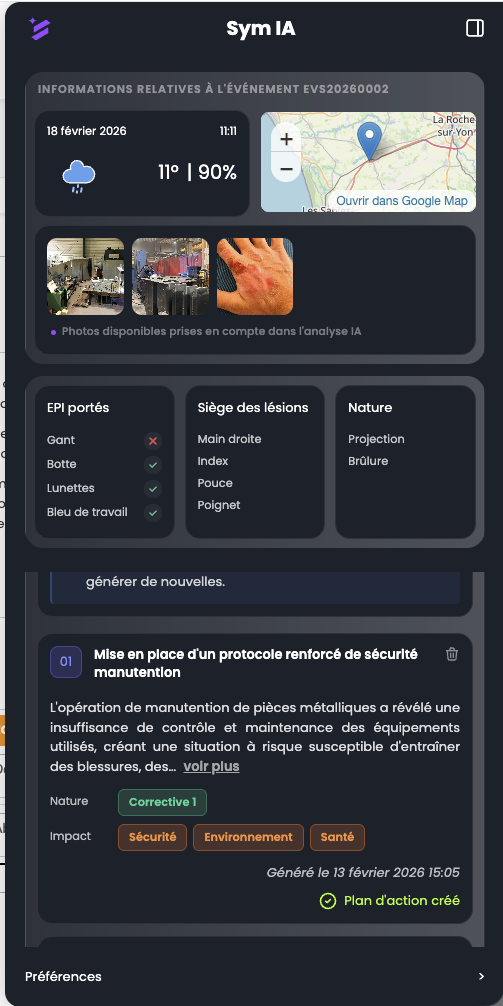
It is in this logic that the Symalean Group developed Regensy.
Software to monitor your carbon footprint: the Regensy approach
Regensy is a solution designed to structure and manage environmental performance.
Concretely, it allows you to :
- Consolidating ESG data
- View emissions by scope
- Identify priority positions
- Follow action plans
- Generate reports that are compatible with regulatory requirements
The objective is not only to calculate a carbon balance, but to make it a continuous management tool.
How to reduce carbon emissions in business : concrete levers
Once the carbon balance has been established, the priority is reduction.
Scope 1 reduction
- Energy optimization of buildings
- Replacing thermal equipment
- Progressive electrification
Scope 2 reduction
- Purchase of renewable electricity
- PPA contracts
- On-site energy production
Scope 3 reduction
- Integration of carbon criteria in procurement
- Supplier dialogue
- Logistics optimization
- Ecodesign products
- Sustainable mobility
Scope 3 involves a transverse transformation. It cannot be handled by the CSR department alone.
Common mistakes to avoid
- Limit yourself to scopes 1 and 2
- Neglecting data quality
- Working in silos
- Do not link measurement and action plan
- Use a non-scalable tool
A carbon footprint must be integrated into the company's overall strategy.
Conclusion
The carbon footprint is now a pillar of corporate ESG strategy. It makes it possible to measure, prioritize and structure decarbonization. But its value depends on its ability to be managed over time.
For SMEs, ETIs and large groups wishing to structure their approach, the question is no longer just “should we do a carbon footprint ?” but : How to make it an operational and strategic management tool ?