Various methods for quality in business
Problem Solving literally refers to the process of resolving issues, meaning the way to provide the best possible response to a critical and unusual situation. In all commonly used problem-solving methodologies (FMEA, 8D, DMAIC), the fundamental step that determines the effectiveness of the solution is the correct analysis of causes, defined in the context of management systems as "root cause analysis."
Kaoru Ishikawa, a Japanese chemical engineer and quality theorist, developed at the turn of the 1950s and popularized in the 1960s a graphical and analytical diagram used to identify the various causes behind an event. Also known as the fishbone diagram or cause-and-effect diagram, it remains the most widely used tool today for properly executing root cause analysis.
Ishikawa diagram is therefore used to define the potential causes of a problem in order to subsequently implement corrective actions. Its popularity stems from the simplicity with which the tool allows for a systematic and visual listing of all possible causes of an effect. It is a tool very often used in brainstorming activities to break down a complex problem into its various factors.
In industry, a specific type of Ishikawa diagram, the 4M diagram, is often used to study problems or processes in the production phase. Compared to a classic Ishikawa diagram, the categories in which to search for the cause of the studied effect are already defined : Manpower, Method, Machine, Materials. Some organizations extend this logic to a 5M or 7M diagram by adding Milieu (Environment) and Measurement: a variant we have detailed in our dedicated article.
Another methodology, complementary to the Ishikawa diagram for analyzing and tracing back to the root of an already identified cause, is the "5 Whys" method. While the Ishikawa helps list all possible causes, the 5 Whys allow you to dig into a specific path until you reach its root cause through successive questioning.
An evolving dimension : AI-assisted analysis
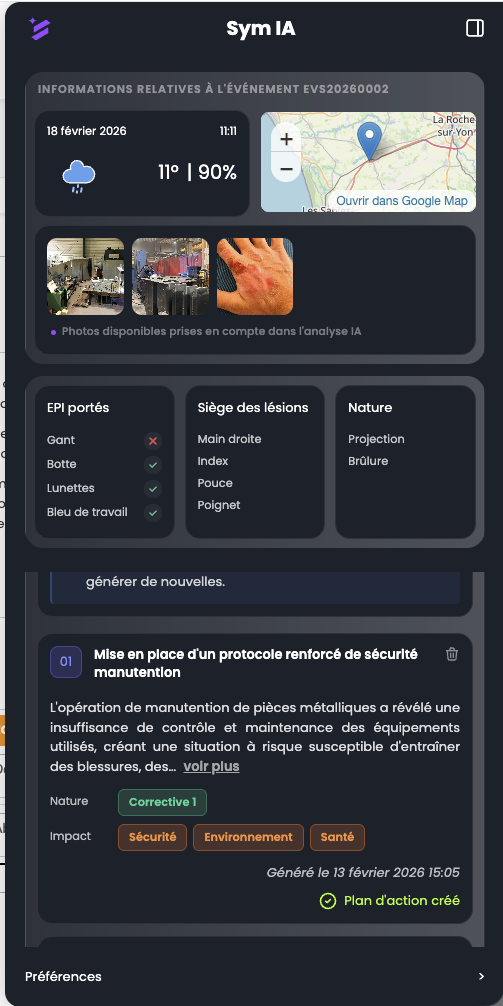
Modern QHSE tools can now assist with root cause analysis rather than simply facilitating data entry. This does not replace human judgment (an Ishikawa diagram remains a collaborative brainstorming exercise), but it can accelerate the identification of recurring causes across a history of non-conformities, a tedious task to perform manually as the volume of events grows.
Structuring your problem-solving approach with QHSE software
Whether for an Ishikawa diagram, the 5 Whys method, or an action plan resulting from an 8D, the challenge is not just methodological, it is also organizational: where do you store the analysis, who tracks it, and how do you verify that the corrective action was actually effective ? The Symalean QHSE Management module integrates these analysis tools directly into the non-conformity process, complete with a tracked action plan and scheduled effectiveness verification.