The origins and conceptual foundations of the "5 Whys" analysis
From Toyota's textile industry to Lean Management standards
The 5 Whys method is attributed to Sakichi Toyoda, inventor, industrialist, and founder of the Toyota Group in the early 20th century. His philosophy was simple: “When faced with a problem, ask 'Why' five times to find its true root cause, then implement a permanent countermeasure.” Later, his son Kiichiro Toyoda and theengineer Taiichi Ohno integrated this approach into the heart of the famous Toyota Production System (TPS), which would give rise to Lean Management and the principle of continuous improvement (Kaizen).
For Taiichi Ohno, the 5 Whys method was the very foundation of a scientific approach to production. He asserted that without this repetitive mental discipline, managers would merely make cosmetic adjustments, masking the plant's structural inefficiencies. In QHSE, this philosophy proved to be a vital tool: it helps bring to light invisible organizational failures which, if left unaddressed, accumulate until an accident trajectory emerges.
The concept of root cause vs immediate cause
To master the tool, the prevention specialist must make a clear conceptual distinction between two types of causes :
- The immediate cause (or apparent cause) : it is the physical phenomenon or direct behavior that triggered the anomaly. It's what is visible to the naked eye immediately after the incident (the oil slick, the deactivated sensor, the sudden movement).
- The root cause (or underlying cause) : it is the higher-level dysfunction, often intangible or organizational, that created the permissive conditions enabling the immediate cause. If the root cause is not addressed, other similar immediate causes will invariably appear elsewhere in the organization.
The goal of the 5 Whys is to build a logical and rigorous bridge between these two realities. The number "5" has no absolute or magical value; it is an empirical average. Sometimes, three questions are enough to reach the organizational core ; sometimes, seven or eight will be needed. The key is not to stop until the identified cause is within the company's direct control and allows for the implementation of a lasting preventive action.
Practical application guide : how to conduct a 5 Whys exercise without going off track ?
The apparent simplicity of the 5 Whys is its greatest danger. Without a strict framework, the exercise can quickly devolve into idle chatter, philosophical speculation, or, worse, a scapegoat hunt. To ensure the scientific rigor of the approach, the prevention specialist must follow a rigorous protocol.
Step 1 : Framing and the indisputable problem statement
Just as with the Ishikawa diagram, an analysis cannot be started on a vague or subjective basis. The initial problem (the starting point) must be a raw fact, validated by all stakeholders.
- Example of a bad start : "Operators are working poorly on line 3." (Subjective, accusatory).
- Example of a good start : "Production batch No. X75 shows a heat seal defect on 14% of units produced on May 18, 2026." (Factual, measurable).
Step 2 : The unfolding of the causal chain (The Rule of Causality)
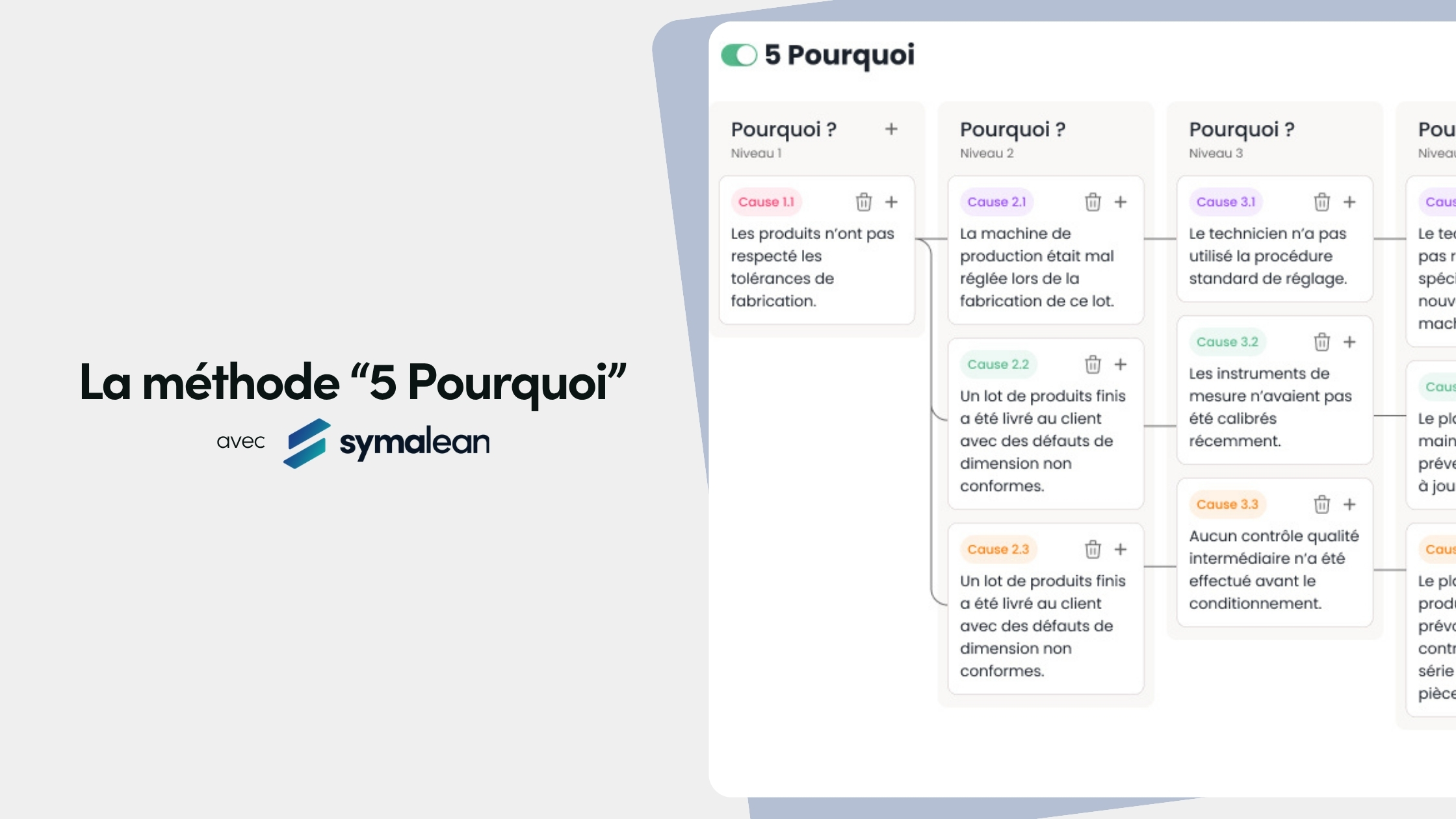
At each step, the question "Why ?" must elicit a response that is the root cause necessary and sufficient of the previous level. Each answer must be formulated positively and factually. If a step relies on an assumption ("I think that...", "It is probable that..."), the chain is corrupted. The investigator must go and verify the information on site (principle of Genchi Genbutsu or Gemba Walk).
Step 3: The Consistency Test by Reverse Reading (The "Therefore" Filter)
This is the most powerful safety mechanism of the method. Once the 5 Whys chain is established from top to bottom, you must imperatively reread it from bottom to top, replacing the question "Why" with the logical connector "Therefore" or "Consequently". If the reverse reading doesn't make sense or sounds wrong, it means your logic is flawed or a link in the chain has been skipped.
Practical Case Study No. 1: Analysis of a Personal Injury Accident (OHS)
Let's apply the method to a typical workplace health and safety scenario: a technician suffered an electric shock during maintenance work on a distribution panel.
[ Problem: The technician suffered an electric shock by touching a live wire ]
                              │
                           Why ?
                              ▼
[ Step 1: The electrical cabinet had not been locked out before opening ]
                              │
                           Why ?
                              ▼
[ Step 2: The technician did not have the required lockout padlock in his bag ]
                              │
                           Why ?
                              ▼
[ Step 3: The maintenance department had run out of padlocks that morning ]
                              │
                           Why ?
                              ▼
[ Step 4: Replenishment was not initiated by the storekeeper ]
                              │
                           Why ?
                              ▼
[ Root Cause: There is no automated min/max alert threshold for HSE stock ]
- The "Therefore" Test (Verification) : there is no automated alert threshold for HSE stock, therefore replenishment was not triggered by the storekeeper, therefore the padlock stock was depleted, therefore the technician did not have their padlock in their bag, therefore the cabinet was not locked out, therefore the technician suffered an electric shock. The logic is irrefutable.
- The Eradication Corrective Action : rather than blaming the technician for their carelessness or the storekeeper for their oversight, the company will implement a continuous inventory system with automatic alerts within its management tool so that safety equipment is never out of stock again.
Case Study No. 2 : Analysis of an environmental non-conformity (ISO 14001)
Let's now analyze a malfunction with ecological impact: the exceeding of suspended solids (SS) discharge limits in the wastewater of a surface treatment plant.
- Why did the TSS discharges exceed the legal alert threshold ?
Because the internal settling tank overflowed. - Why did the tank overflow ?
Because the sludge filters were saturated and clogged. - Why were the sludge filters saturated and clogged ?
Because the weekly cleaning frequency was not adhered to. - Why was the frequency not adhered to ?
Because the primary operator was absent, and their replacement did not have this task scheduled on their replacement schedule. - Why was this task not scheduled on the replacement's schedule ?
Because the environmental business continuity plan (BCP) procedure does not list Level 1 maintenance operations as priorities during short-term absences.
- Root Cause : The business continuity plan (BCP) overlooks primary environmental compliance obligations during crisis management reorganizations.
- Eradication Corrective Action : Rewrite the absence management procedure to mandatorily include the transfer of tasks with strict environmental impact. To manage all these regulatory deviations and avoid penalties from DREAL inspectors, plant managers rely on Symalean, the QHSE ISO non-conformity management software, which automates the assignment of emergency tasks in the event of an environmental anomaly.
The psychological and methodological pitfalls awaiting the prevention specialist
Although it seems accessible to everyone, the 5 Whys method is one of the most poorly executed tools in business. The human mind has natural cognitive biases that tend to sabotage the rigor of causal analysis. The HSE manager or facilitator must act as a guardian to avoid four major pitfalls.
Pitfall #1 : The human error bias
This is the absolute trap in occupational health and safety. The analysis stops dead at the second or third "Why" with this type of answer: "Because the operator made a handling error" or "Because the facilitator forgot to check". Stopping at human error is a major methodological flaw.
Human error is never the cause of a problem; it is the consequence of a system that made it possible, probable, or inevitable. If an operator makes a mistake, you need to look for why the system allowed that error to occur without a safety barrier blocking it. Is it a lack of ergonomics ? Excessive mental load ? Accumulated fatigue ? A lack of clarity in training ?
To eliminate this punitive and counterproductive reflex, companies must imperatively develop environments of trust. It's impossible to conduct honest 5 Whys if personnel fear being sanctioned for telling the truth. The role of management is to learn how to establish a safety culture in your company in 2026, a just culture where open communication is encouraged to heal the organization rather than blame the individual.
Pitfall #2 : The Dead End of Linear Thinking
The classic 5 Whys method assumes that a problem develops in a straight line : A causes B, which causes C, which causes D. However, industrial reality is often multifactorial. An event is frequently the conjunction of several simultaneous causes.
If you confine yourself to a single straight line, you risk choosing one analytical branch at the expense of another equally important one. For example, an operator's lack of gloves during a cut could be explained by a stock issue (Method), but also by an untreated latex allergy (Human), or by an excessively high temperature in the workshop (Environment). If the 5 Whys analysis becomes too complex or branches into several parallel trees, the prevention specialist must instinctively switch to more comprehensive tools by relying on a structured occupational safety module capable of managing the intersection of methods (5 Whys embedded within an Ishikawa diagram or a cause tree).
Pitfall #3 : The Drift of Political Expediency
In many organizations, certain topics are taboo. Tracing back the chain of "Whys" can sometimes lead to highlighting strategic decisions by general management, drastic budget cuts, or questionable management choices. Faced with this political barrier, the working group tends to self-censor and stop at an "acceptable" cause to avoid offending management.
A good prevention specialist must demonstrate managerial courage backed by objective facts. If the root cause of an accident is a recurring lack of budget for compliance with protective equipment, this cause must be stated in black and white. To support this finding to management without appearing to lecture, it is strategic to link safety to the company's overall performance. By recalling key indicators, such as those developed in our analysis on PPE and occupational safety, key drivers for effective protection, the prevention specialist demonstrates that a euro invested in safety is a euro saved in costs of poor quality and lost workdays.
Pitfall #4 : Infinite Regression
Unlike those who stop too early, some working groups don't know when to stop. By asking "Why," one can end up drifting towards abstract, universal, or external concepts over which the company has no power to act : "Why is the global economy in crisis ?", "Why are humans fallible ?", "Why does Earth's gravity make objects fall ?".
The stopping rule is simple: the exercise concludes once a cause is identified that allows for the definition of a concrete, measurable action, and within the company's operational control. If the identified cause does not lead to any realistic course of action, it means you have gone too far or deviated from the core of your problem.
Digitalizing the 5 Whys method : preserving organizational prevention knowledge
In the industrial and service landscape of 2026, using scattered Excel files or paper forms to record problem-solving sessions has become obsolete. The digitalization of QHSE tools transforms the 5 Whys method from a simple meeting exercise into a living, interconnected knowledge base.
Seamless integration with the overall action plan
The main flaw of traditional 5 Whys is the lack of follow-up on countermeasures. The analysis is brilliant, recorded in meeting minutes, then forgotten.
Thanks to modern cloud software architectures, the 5 Whys exercise is directly integrated into the company's action plan. Each link in the "Why" chain can be connected to a specific corrective action. If the root cause is identified as a failure to update temporary workers' skills, the system automatically creates an audit task in the HR/Safety module. To automate this entire chain, from the initial field report to the closure of the action, integrating the method within the Symalean work accident management software ensures that no root cause remains without an operational response.
Cross-site knowledge capitalization (experience sharing or REX)
For multi-site companies or large industrial groups, digitalizing the method creates invaluable synergy. When a plant in Lyon resolves a complex line stoppage problem using the 5 Whys, the analysis is immediately indexed in the group's shared database.
If a similar plant in Nantes encounters the same type of incident three months later, the local prevention officer doesn't need to reinvent the wheel. By querying the system, they can access the causal tree already validated by their colleagues, saving valuable time and preventing the company from making the same mistake twice.
The power of cross-semantic analysis
By centralizing all your non-conformity "5 Whys" in one place, you enable the system to cross-reference the texts. You can perform macro-organizational analyses using powerful visual and statistical indicators. The system can alert you : "Warning: in 42% of Quality or Safety non-conformity analyses conducted this year, the final root cause refers to an integration defect during team shift changes (3x8)". This level of visibility allows the QHSE director to propose structural transformation projects to general management, based on real data rather than intuition.
How SymAi Revolutionizes 5 Whys Modeling
While human facilitation is irreplaceable for confronting viewpoints and validating facts, the logical structuring and input of the root cause tree can be tedious for an HSE facilitator.
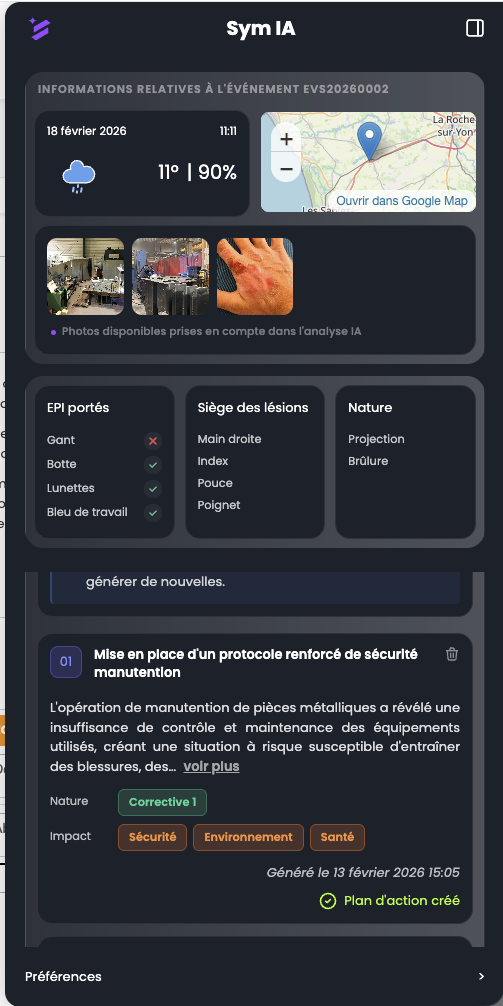
This is where the added value of cutting-edge technological innovation becomes apparent. Our intelligent agent SymAi, the GDPR-compliant QHSE business AI agent, can scan all your safety meeting minutes, accident reports, and transcribed audio from your field debriefings. Thanks to Natural Language Processing (NLP), SymAi instantly structures a coherent 5 Whys tree proposal, self-validating the logical soundness of the reverse test (the famous "Therefore"). The prevention specialist is no longer a data entry clerk : they become an arbiter of consistency, freed from administrative tasks to focus on what truly matters: deploying safety barriers in the field.
The "Why" in Service of Operational Excellence
The 5 Whys method transcends the strict framework of occupational health and safety. It is a philosophy of global performance management. Asking "Why" five times in a row means refusing to accept fate, rejecting the mediocrity of easy explanations, and making a conscious choice to build a learning and resilient organization.
In 2026, in the era of interconnected industry and accelerated digital transformation, prevention specialists and QHSE managers must rely on streamlined and robust analysis methodologies, powered by collaborative digital tools. Only under this condition can companies sustainably eradicate risks, optimize non-quality costs, and offer their employees an impeccably safe working environment.


.png)